

For well over a century, the term ‘Oxbridge’ has been a useful abbreviation to indicate the two most prestigious universities in the UK. It has stood for the highest caliber of research, the brightest minds and absolute academic freedom. To be associated with Oxbridge is to have links with the very best that higher education can offer.
Not anymore.
Thanks to a number of articles in El Pais and Science among others, the term Oxbridge is now associated with a picture of a nice house in England, and journals bought and sold under mysterious circumstances. Welcome again to the murky side of academic publishing.
Not cricket
Oxford and Cambridge are the two oldest universities in the English-speaking world, and regularly hog the top spots of whichever university ranking you choose to look at. The term Oxbridge has an interesting background, coming into use briefly in the early nineteenth century before growing in use since the 1960s (see graph). While a useful portmanteau term for both universities, it also has a pejorative connotation for many in the UK, using it to symbolize privilege, class, and elitism in higher education and society as a whole.

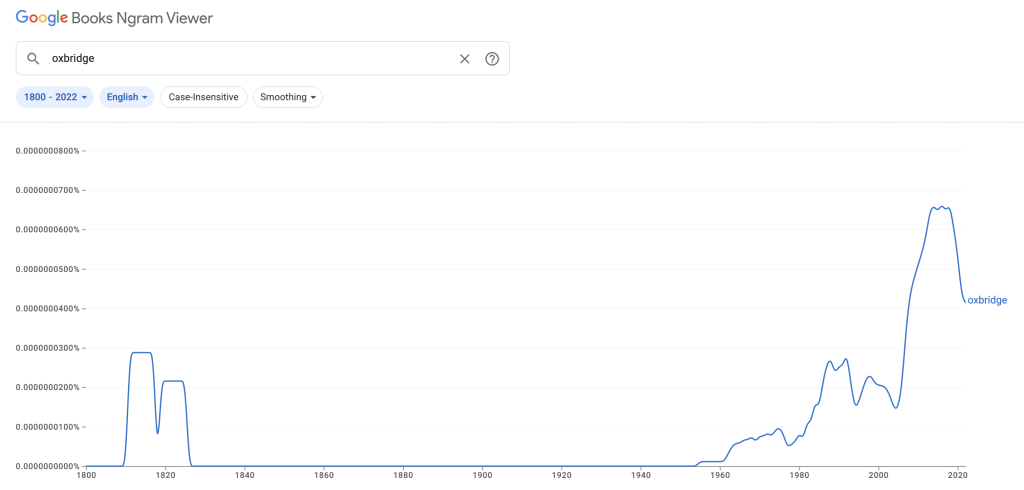
As we covered several years ago, using words like ‘British’ in a journal title can be 10 times more likely to indicate predatory behavior. For every esteemed British Journal of Medicine or British Food Journal, there will be several predatory titles that use the same word – the British Open Journal of Buildings, The British Journal of Sports Medicine, and the British Journal of Marketing Studies to name just three of the hundreds of such titles included in Predatory Reports.


However, outside of British class critiques, the term Oxbridge is likely to bestow only positive vibes on any academic publication to the uninitiated, which is of course why the use of this word is not understandable from a marketing point of view, but also highly questionable when one knows how such terms are used by predatory publishers.
Story so far
If you have missed the background to these shenanigans, the story first came to prominence at the start of the year in a preprint article posted on Zenodo (and later shared by The Geyser newsletter) by two Spanish authors highlighted the issue of ‘journal snatchers’, where established journals had been acquired by third parties, only then to show some odd behavior afterwards. These journals tended to have been indexed by Web of Science, Scopus, or Cabells, but post-acquisition started to change operations, such as hiking publication fees or using fake digital object identifiers (DOIs).
There were several publishers and journals implicated based all around the world, and one of them was Oxbridge Publishing House (NB: we are not sharing the link as there is no current security certificate for this site, so proceed with caution). This publisher was covered in some subsequent reporting in El Pais and L’Express in Europe, in part due to the grand house it appears to be based at in suburban England. As someone who has dug into the backgrounds of suspicious publishers, it was a change to see such a nice HQ – usually it is a lock-up garage or faceless office complex that supposedly houses a publishing operation producing 800 journals.


Deeper problem
While it is undoubtedly good news that publishing practices are receiving this kind of scrutiny, it is hard to escape the feeling that, despite this, publishers whose operations are questioned in such a way can continue to publish their journals, either in the same form or simply via a different platform. Many of the journals identified in Predatory Reports continue to operate and even grow their publishing operations despite any scrutiny they may receive.
It is worth stating for the record that Cabells is itself undertaking its own review of Oxbridge’s journals, and subsequent reporting in Nature has highlighted further questions to answer on their behalf (although few seem to be appearing). The scrutiny of any publisher exhibiting suspicious characteristics must be investigated, and hopefully this will strengthen the many legitimate publishers seeking to publish the highest standard of research and further highlight the dangers such publishers can pose to the validity of academic research and its record. But this call for more action and better education is becoming tired and seems to go largely unheeded. We need to do more.