
In 1998, the UK and Irish governments negotiated a peace deal for Northern Ireland, which largely brought decades of sectarian violence to an end. At the time, UK Prime Minister Tony Blair said:
“A day like today is not a day for soundbites, we can leave those at home, but I feel the hand of history upon our shoulder with respect to this, I really do.”
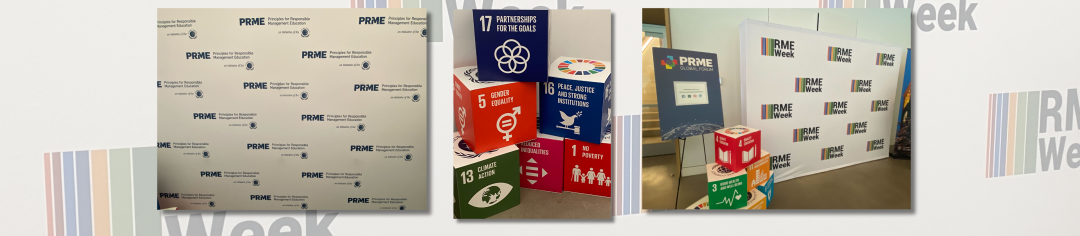
Leaving aside the obvious contradiction inherent in this statement, the ‘hand of history’ phrase stuck and has been used many times since. This week, the great and the good of the UN and management education gathered in New York for Responsible Management Education Week. Some delegates may reflect on these words as they review their role in the progress the UN’s Sustainable Development Goals (SDGs) have made so far, and how they can help achieve the goals in five short years. But that hand may have a cold chill to it.
Near and far
When the UN adopted the SDGs ten years ago, 2030 must have seemed a long way off. Building on the progress of the Millennium Goals earlier this century, the SDGs were broadly welcomed by the world of research to focus energies on new discoveries and innovations that would have a real-world impact on society, something for which many had been clamoring for years.
Relatively quickly, some things started to change around research activities. Funding gradually shifted towards the 17 SDGs, some governments openly encouraged their universities to work towards them, and publishers launched new journals that showcased these new streams of research. Soon, the familiar circles of 17 colors could be seen everywhere, and the scholarly communications industry, in particular, seemed to take them to heart, forming supporting initiatives such as the SDG Publishers Compact and Compact Fellows.
Future forward
RME Week is a shared event held this year on Cornell Tech’s New York City campus with different days hosted by the UN’s Principles for Responsible Management Education (PRME), AACSB, and Responsible Research for Business and Management (RRBM). The aim of the week, first held in 2023, is to ‘advance responsible management education and its impact worldwide through convening and knowledge exchange.’
Through its various bodies and partnerships, the UN has been well aware that promoting the vital role that education plays in supporting the SDGs is a key component in achieving the goals overall. Everyone involved in RME Week hopes that by addressing the wealth of issues surrounding the SDGs and sustainable development in general in the context of management education, the seeds are sown for future generations to take sustainability seriously and have positive outcomes as a result.
Tipping point
For all the activities and favorable attitudes towards the SDGs, the stark truth is that it is becoming increasingly likely that they will not be realized. Recent reports suggest that most of them will be missed, with the UN itself admitting in October last year that only 17% of the targets will be reached. In 2025, we have also seen a number of governments roll back on some environmental commitments in the face of slow growth and changing attitudes towards sustainability, which means the goals seem even further away from our grasp.
However, the SDGs were never expected to solve the world’s problems by 2030, but rather to put us on a more sustainable path. Looking at the long game, events like RME Week very much have their sights set on the managers and researchers for the next 20-30 years. The theme of the week – ‘Community and Commitment to Advance Global Responsibility’ – speaks to the strengths of all those involved, tapping into their global networks and forward-thinking outlooks. If those in New York embrace this, look beyond short-term government thinking and laser-focus on research impact, then maybe that hand of history won’t feel so uncomfortable.
