
Tomorrow I will have the honor of giving a lightning talk at the annual ALPSP Conference in my home city of Manchester in the UK. This is not just a highlight for me, but for those in the publishing community who are able to visit this wonderful city. As usual, there is much to delight delegates in a varied and packed agenda.
It is easy to identify the hot topics of the moment for publishers by looking at the ALPSP program, and this year is no exception, with AI nudging just ahead of publishing ethics in terms of interest. Of course, these two topics intersect not inconsiderably, and it is perhaps in this overlap that we see both the greatest challenges and greatest opportunities for publishers in the near future.
Navigating AI and ethics
As a representative of Cabells, I will be briefly showcasing our new CompassAI feature in the lightning talks on Thursday afternoon at ALPSP. In case you missed it, CompassAI helps authors, librarians, and research managers to optimize their decision-making over choosing the right journals. Whether you want to publish your research, decide which journals you should add or remove from your library, or assess the ethics of outputs from individual researchers, CompassAI can help.
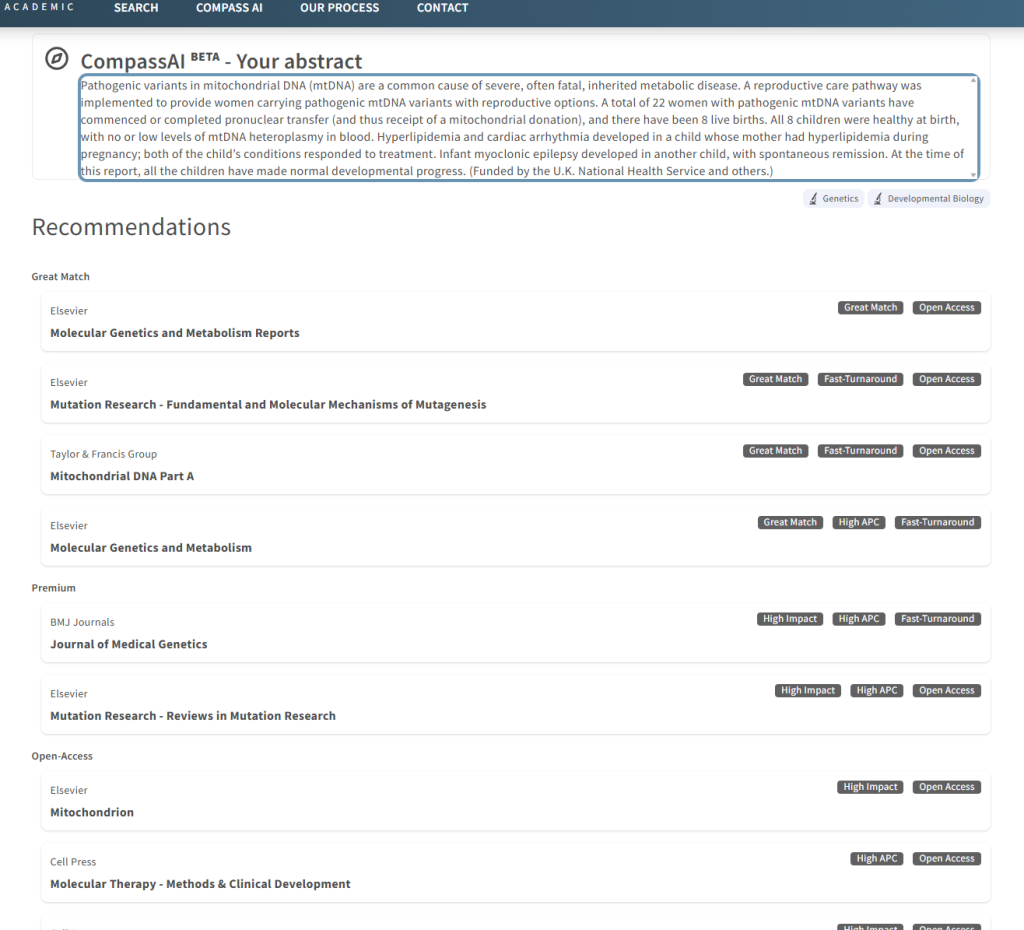
Simply input an abstract into the special CompassAI field, and a combination of AI and verified data from our Journalytics databases will give you a list of journals best suited to your needs – the Best Match in terms of research and journals, best options for Open Access, and the Best Value if you are paying an APC to publish. The feature is currently under its beta phase, which means that any Cabells customer can experiment with it, and we have already received some fascinating feedback from users.
Future focus
More details will be shared on CompassAI in the talk, which will sit alongside a whole host of interesting presentations from the likes of Elsevier, Springer Nature, and the Copyright Clearance Center. All of these talks will look ahead to the somewhat uncertain future facing the scholarly communications industry as a whole, summed up by some of the other sessions at the conference. These include titles such as ‘Bridging the Gap: Community Involvement in Academic Publishing’, ‘Licensing Content in the Age of Generative AI: Obstacles, Opportunities, and …. Optimism?’, and the intriguingly named ‘Scholarly Communication Musical – Flimflam at the FAIR: A Metadata OAsis in a Misinformation Maelstrom’.
The questions and sense of uncertainty present in these and other sessions perhaps hint that the industry is at something of a crossroads. The harder we try to look into the future to estimate how things could play out, the more vague and unpredictable everything appears. As geopolitical changes swirl around us at a seemingly ever-increasing speed, being able to focus on even our day-to-day priorities feels more difficult. It is a good time, then, to convene in the city where Mr. Rolls met Mr. Royce and Alan Turing did his research to discover for ourselves if we can share ideas and bring clarity to the challenges we face.
