



For those of us who have been in scholarly communications for a number of years, one of the most noticeable shifts in the industry has been the use of language and how it has morphed from being almost historical in nature to being at the cutting edge of the ‘tech bro’ vernacular. These days in publishing houses – itself a joyously arcane term these days – one cannot move for agile scrum masters and prompt engineers swarming round their kanban boards.
The adoption of the latest software development and product management techniques have enabled publishers and vendors to be more user-focused in their approaches, which has inevitably benefited customers and the industry as a whole when it comes to effective and efficient innovation. But one hopes there is still room for some level of synchronicity, or even luck, when it comes to grasping what might make a successful product.
Happenstance
The classic example of such a development occurred when, as the story goes, an employee of 3M accidentally created a weak adhesive while trying to develop a stronger one. Years later, another 3M employee used it to create a bookmark that wouldn’t fall off the page, and this was eventually commercialized into the ‘Post-It’ product over a decade after the original discovery.
While it wasn’t meant to happen this way, product developers trust users to feed back both problems they have found with new products, as well as completely new uses, neither of which entered into the developers’ heads during the development process.
New directions
We at Cabells learned the truth of this recently, following the ‘beta’ launch of our CompassAI feature for our Journalytics products. A beta launch is where a new product or feature is released for ‘real-world testing’, and can be improved upon ahead of a full launch at a later date based on user feedback. We beta-launched CompassAI as AI technology, in particular, lends itself to user testing to understand which aspects of the tool are most useful, and we have been studying usage trends since the beta launch in the summer.


CompassAI uses advanced AI to match a research article’s abstract with the databases of verified, high-quality journals from Cabells’ Journalytics databases. The primary use case is for a researcher to receive in seconds what they may take hours or even days researching, which is a suggested list of journals their research might be suitable for.

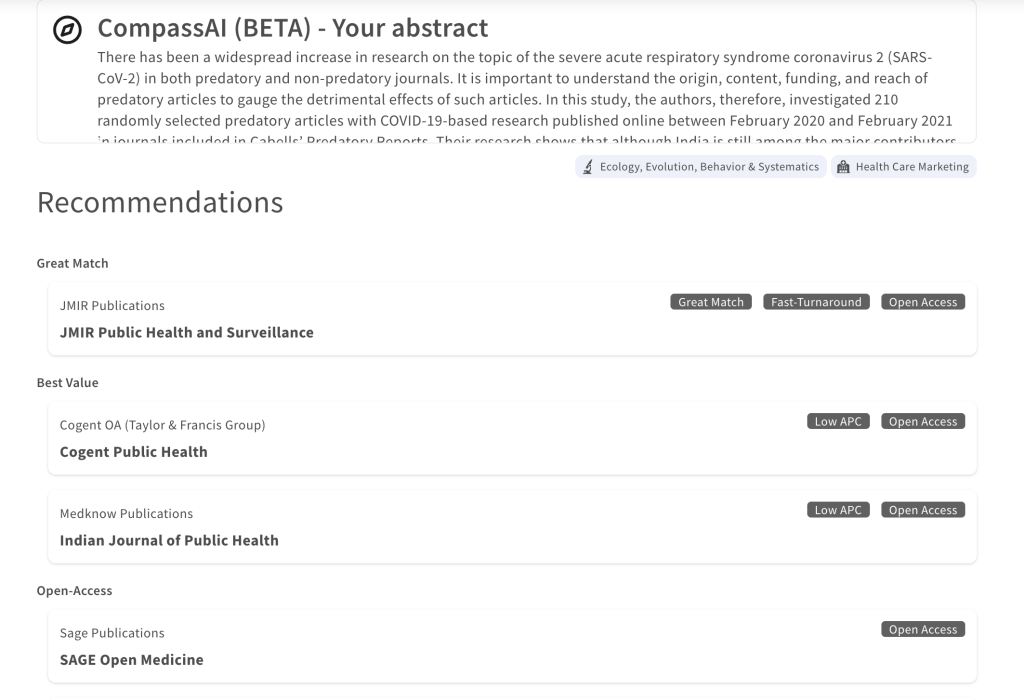
One of the revelations to us has not only been entirely new use cases that have been presented back to us, but also new interpretations of the value the tool has for university professionals. For example, some users have been using the tool to identify other journals they should look at for relevant material to support their current research. In addition – and perhaps most gratifyingly – one research librarian told us they were overjoyed as the new feature was, in their words, “non-publisher-specific,” and as such they could recommend it to their researchers. Cabells has been proudly independent for nearly 50 years, and publisher-agnostic all that time, but we hadn’t understood how integral this was to the relevance of the use case until we got the feedback.
Just goes to show, it isn’t just dev teams that can learn from beta launches – marketing teams can be schooled just as much.