
Einstein defined madness as doing the same thing again and again while expecting a different result. Current world events may lend support to this particular theory, but it is certainly not a new phenomenon. Indeed, one of the wisest lessons for authors is more than 2,500 years old.
Aesop was believed to have been a slave and storyteller in Ancient Greece, and it is remarkable that so many of his parables have been passed down over the centuries. One of the more famous tales concerned a fox that finds himself stuck down a well only for a kindly goat to come along. Spotting his chance, the cunning fox persuades the goat to jump down to drink the fresh water. When the goat obliges, he jumps on the goat’s back and out of the well, leaving the goat stuck and giving birth to the phrase ‘look before you leap.’
Modern context
Sadly, the world of publishing seems to have more than its fair share of sly foxes in the shape of predatory publishers, with 20,000 journals now included in Cabells’ Predatory Reports. And there are also some goats in the shape of authors who, unfortunately, fail to heed Aesop’s advice and don’t check the provenance of the journal they intend to publish in. With so much uncertainty in scholarly publishing, as in the wider world, trusted sources of information like Predatory Reports have rarely been as valuable.
To illustrate, a recent story that Cabells collaborated on with Retraction Watch shows just how brazen predatory publishers can be in their nefarious activities. On March 5th, Retraction Watch reported that a publisher had demanded $500 from an author to retract a paper, even though the author’s name had been copied and used for an article they hadn’t actually written. While the authors in this story did not submit their articles to the journal in question, hundreds of others have published in this and other journals published by the same outfit. And stories like this are likely to shine a light on those publications, which could spell trouble for those authors who may find themselves the victims of attempted blackmail as well.
Fool’s gold
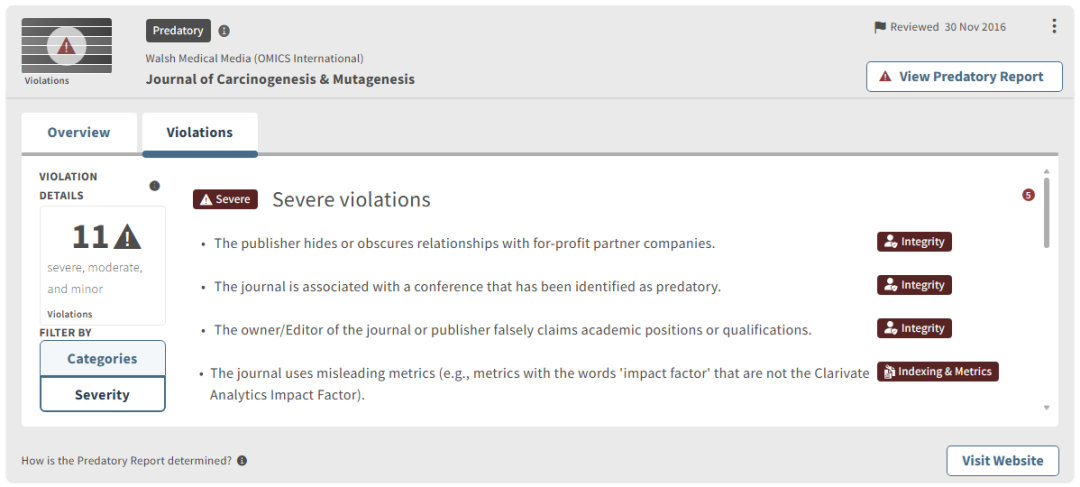
The journal in question – the Journal of Carcinogenesis and Mutagenesis – has been added to Predatory Reports following a review and joins over 70 other journals included from Walsh Medical Media. It appears this publisher is yet another imprint from OMICS, the world’s largest publisher of predatory journals with well over 700 titles included in Predatory Reports. Creating new imprints is a hallmark of the larger predatory publishers, changing identities so as to appear different from more well-known imprints. However, the site architecture and design traits are often similar – for example, see the claim from the journal homepage below about a “20+ Million Readerbase,” using poor language and hyperbole typical of an OMICS title.

Such claims can appear attractive to authors if they don’t check them out, as do fake metrics such as an Impact Factor of 3.02 the journal claims to have. This is a clear, verifiable breach of publishing ethics and one of the most severe violations which Cabells uses to identify and include predatory journals in its database. Once authors submit their article to such a journal – or in the Retraction Watch story simply become aware their identities had been stolen – then this is the opportunity predatory actors take to ‘jump on the goat’s back’ and try to profit from them as much as possible. The moral of the story, therefore, is not just to ‘look before you leap’ but also brings to mind the Japanese proverb ‘ishibashi wo tataite wataru’, or ‘tapping a stone bridge before crossing it’. In other words, you can never be to careful when it comes to entrusting your research with others.
