


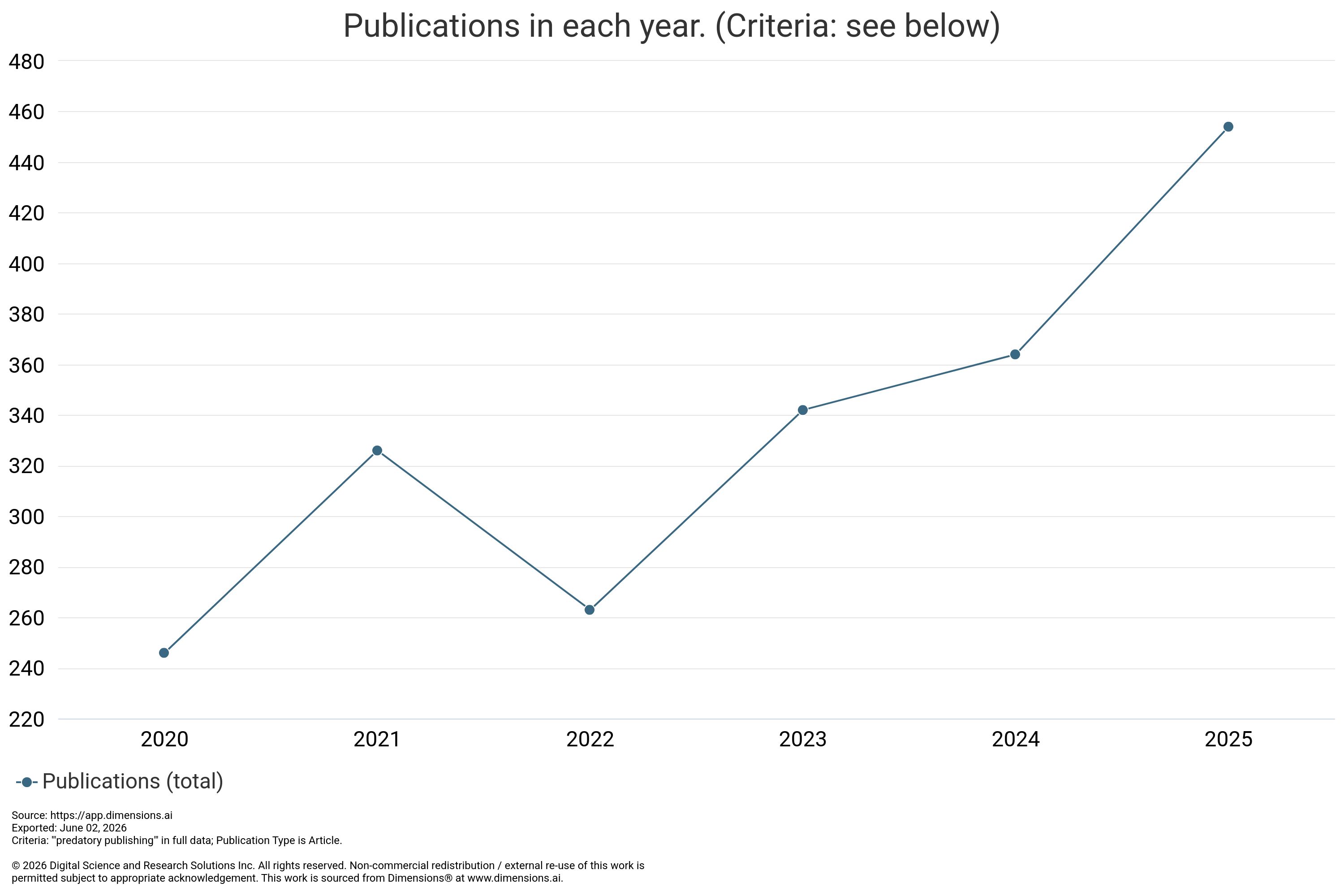
The simplest way to learn about predatory journals and their tricks of the trade is to look at the burgeoning number of articles on the topic. Since 2020, there have been over 2,000 research articles published that mention ‘predatory publishing,’ with the rate increasing over time. Indeed, as you can see from the graph below, aside from the spike in 2021 and a fall back in 2022 following the pandemic, we have seen year-on-year increases so that 2025 was the biggest ever year for published research on the topic.

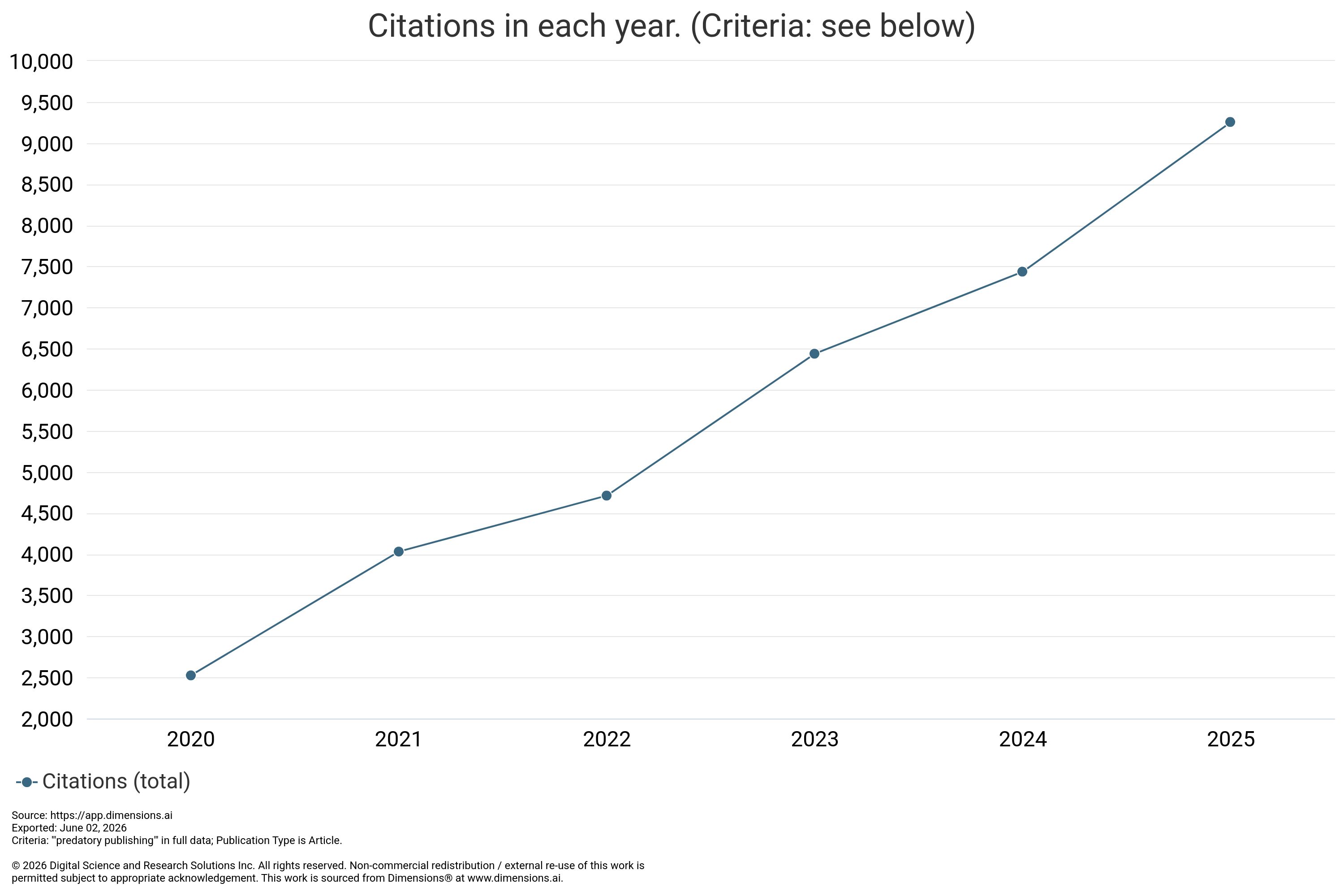
Not only is the trend for publishing research increasing, the number of citations that have accrued to that research during the same period has also gone up. As we can see in the second graph, the rate has been increasing consistently since 2020, with the rate of increase also growing in recent years, with the total number of citations to articles mentioning predatory publishing standing at over 43,000.
Rich seam
With all this activity, it is not surprising that published research in this area provides ideal conditions for authors to mine information about the predatory journal phenomenon. While we are only five complete months into the new year, there have already been over 200 articles on the topic, so perhaps now is a good time to turn the spotlight on some recent articles that represent the latest research in the area.
The first article was written by Emilia Kaczmarek and titled ‘Why the Current Model of Academic Publishing Is Ethically Flawed—and What We Can Do to Change It.’ Kaczmarek argues that the current scholarly communications framework is not fit for purpose and incentivizes unethical behavior, including the introduction of bad actors such as predatory publishers. It is a familiar refrain shared by many other articles, but rather than just highlight the issue, the author presents a number of fixes to improve the system, focusing on maintaining and improving ethical standards, suggesting now is the time to act before things get any worse.
New perspectives
Many of the articles published on the topic of predatory journals tend to focus on a specific discipline and highlight the same issues as other articles, just through a subject-specific lens. Therefore, it is good to see research that has a more original take on the issue, such as the article by Siler et al, ‘Identifying National, Institutional and Disciplinary Sites of Probable Predatory Publishing.’ Using a deep dive into published data and metadata, it is able to debunk some myths around predatory publishing, such as the role played by authors from developing countries. For example, the authors found that while they publish a large number of articles in predatory journals, revenues are actually driven by authors from Western countries and high-status institutions.
Two further articles also focus on research integrity issues, but from the perspective of two specific countries. In their article ‘Who Becomes the Prey of Predatory Journals: A Glance at the Tip of the Iceberg,’ Parray et al break down authorship trends within Indian provinces and institutions. Sharing a countrywide focus is the paper by Huang JInxia et al titled ‘Postprint of a Study on the Definition of OA Predatory Journals in the Context of Global Over-commercialization of Scientific Journals,’ which offers a rare perspective from China on predatory publishing.
Final call
The final article worth highlighting is by C Vysakh and titled ‘Predatory journals and their societal impact: a case study based on Beall’s list and altmetric.com.’ While the article itself is moderately interesting – offering insights into how little predatory journals are actually covered in social media – it also typifies the reliance on Beall’s List for predatory journal identification. This use of Beall’s List as a source of data is not only unacademic given the well-known problems with the lists, but also hugely outdated as it is now over nine years since Beall shuttered his website. Using academic research to improve one’s knowledge about predatory publishing practices is a wise move, but it also needs to be aligned with a critical approach when it comes to source materials.