
Since November of last year, our team has been contacted by the national public broadcasting networks of both Japan and Germany to provide information related to our work investigating and reporting on predatory journals. In both cases, the journalists were asking specifically about publications focused primarily not on generating profits, but rather on spreading misinformation or disinformation. This coincides with a small but notable shift our journals team is seeing more and more while carrying out its work, especially since the pandemic.
In December, a journalist from ZDF (Zweites Deutsches Fernsehen), Germany’s national public television broadcaster, contacted us to provide background and answer questions for an upcoming documentary on predatory journals. Specifically, the documentary will examine how false and defective studies spread and are shared as fact-based, peer-reviewed science in media and social networks.
This inquiry came just weeks after a request from a producer from NHK, Japan’s public broadcasting corporation, seeking an on-camera interview with someone from our team for a news program examining the spread of misinformation and disinformation throughout 2024. We were contacted to take part in a segment covering vaccine misinformation, specifically addressing the challenges posed by predatory journals and their role in spreading misinformation within academic and public spheres.
International Journal of Vaccine Theory, Practice and Research (IJVTPR)
The NHK segment highlighted one journal in particular, the International Journal of Vaccine Theory, Practice and Research (IJVTPR), a controversial journal that played a part in the propagation of the false rumor that Japan had declared a state of emergency last year after a study published by IJVTPR was cited to support a vaccine misinformation campaign. This same study can be found on at least one official U.S. state government health department website with no context or disclaimer as to why it is there (it was included by a citizen as supporting documentation at a virtual town hall during the pandemic).
The journal has been a source of misinformation since it launched in 2020 and the false rumors and panic caused in Japan last year are a recent example of just one of the ways the spread of misinformation causes harm. Other research published by IJVTPR, undergoing the same “peer review” and so marginalized, at best, is available on research platforms, is shared widely on social media, and on news websites.
IJVTPR in Predatory Reports
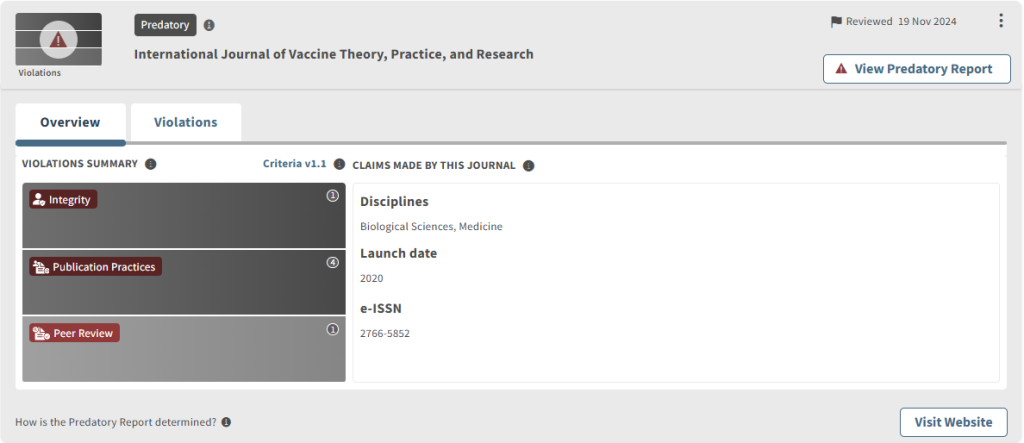
Due to the vast and expanding number of journals currently in publication globally, our team is continuously working on evaluations of both legitimate and deceptive outlets. Our Predatory Reports platform alone will soon include more than 20,000 journals. We are alerted to the activity of potentially predatory journals in several ways, including inquiries by organizations such as NHK. After conducting our own independent evaluation of IJVTPR, the journal was added to our Predatory Reports platform.
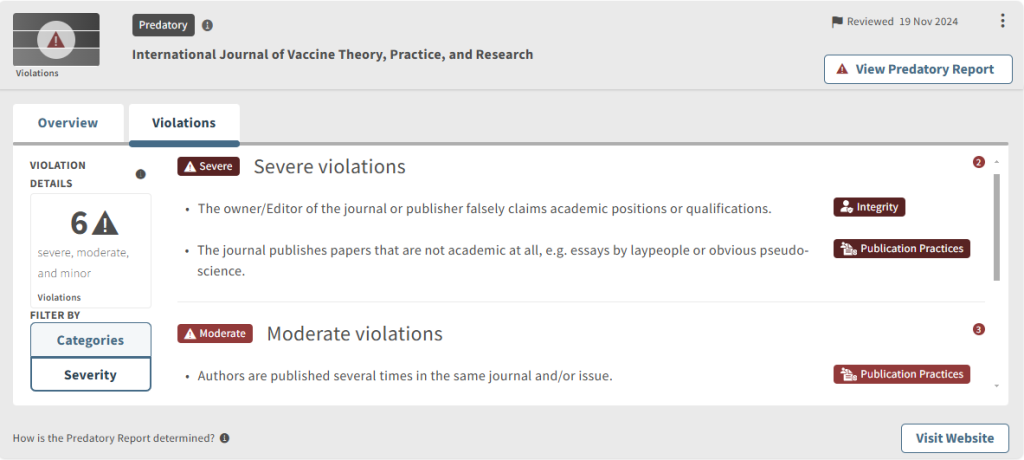
By maintaining a rigorous evaluation process for identifying predatory journals, we aim to limit their reach and mitigate the damage they cause.
The growing recognition of the role predatory journals play in the spread of misinformation is a crucial step in addressing the broader challenge of research integrity. The inquiries from ZDF and NHK highlight how deceptive journals like the International Journal of Vaccine Theory, Practice and Research continue to mislead the public and fuel misinformation campaigns. As we’ve seen, misinformation published in these journals does not remain confined to academic circles; it spills into public discourse, influences policy decisions, and, in some cases, compromises public health and safety.
Cabells remains committed to exposing deceptive publishing practices and equipping researchers, institutions, and policymakers with the tools needed to navigate the scholarly landscape responsibly. The challenges posed by predatory publishing are ever-evolving, but through vigilance, transparency, and collaboration with global media and academic communities, we will continue our work protecting the integrity of scholarly research.

Thanks for an insightful article.We tend to see “publishers” as the culprit and origin of the predatory issue.I personaly think that those feeding these publishers are as guilty ( if not more) than the so called publishers .The problem is even more serious in The Global South where centralized and governmental bodies are pushing and subsidizing the phenomenon .That is done to supposedly have better ranking and Impact Factor while it is just perverting an already biased field .Financially attracting well known names to publish under the institutional mail of the country ( Saudi Arabia for instance ) is a form of predation .As predation is more and more shunned , its forms are becoming more and more diverse and sophisticated .As “honest ” researchers, we should fight it with all our forces