
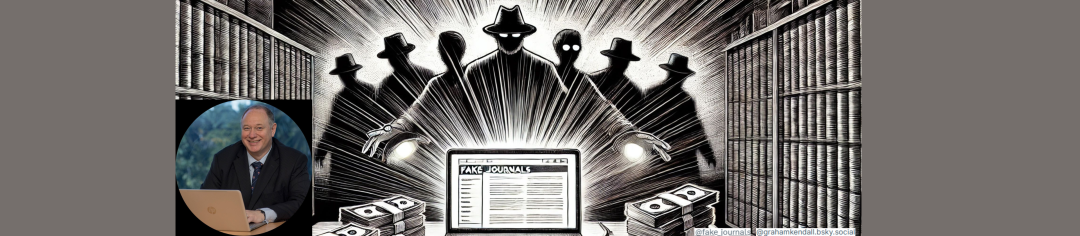
In September 2024, Graham Kendall caused something of a stir when he ‘outed’ himself as the person behind @fake_journals, the popular Twitter/X account highlighting the problems caused by predatory journals. Cabells’ Simon Linacre – a research collaborator with Professor Kendall – asks him about his background and focus on publishing ethics, including why he chose to remain in hiding for so long (including from Simon himself!).
Q (Simon): Graham, you have had long and distinguished careers in research and university administration before achieving prominence on the topic of predatory publishing. Before we get on to this third act, can you tell us something about your background?
A (Graham): I left school at 17, with three ‘O’ levels. I did not want to stay on and do ‘A’ levels, as I did not see the point. At that time, I did not know that they were your entry to university. In fact, I did not know anybody who had a degree, going to university was never discussed, and, if truth be known, I did not even know that it was an option. I just assumed I would leave school and get a job. So, I left school and got a job as a computer operator, working on ICL mainframes, back in the day of punch cards and paper tape. I remember, once I had the job, going to the school library to look for books about “computers.” There weren’t any.
Seventeen years later, in 1994, aged 34, I held a senior IT position and decided that I would give up my industrial career and do a Computer Science degree. I thought “How hard can it be, as I have 17 years IT experience?” In fact, it was hard. At my very first lecture, I suddenly understood the difference between IT and Computer Science. I knew that I understood IT but knew nothing about Computer Science.
My plan was to do my undergraduate degree and then, in 1997, go contracting to help sort out the Y2K bug. But I was offered a Ph.D. position, which took me through to 2000, by which time the Y2K was sorted.
Two years into my Ph.D., I was offered a lectureship, which I took, so I was now an academic, rather than an industrialist.
I progressed through academia and became a Professor in 2008, and moved to Malaysia in 2011 to head up the Research and Knowledge Exchange portfolio of the University of Nottingham’s campus near Kuala Lumpur. In 2016, I was fortunate enough to be given the opportunity to head up the Malaysia campus as Provost/CEO. I was also a Pro-Vice Chancellor of the (global) University of Nottingham.
It was an honour to head up the campus, which comprised a 125-acre estate, about 5,000 students and 650 staff. As the Provost/CEO, one of my pleasant duties was to confer degrees, and when shaking hands with our graduates, I always reflected that a boy from a council estate, who did not even know what a university was, was now awarding degrees. When people say, as I did at every graduation ceremony, that “Education can transform lives,” I know that it is true, as I am living proof.
When I left the University of Nottingham (I am now an Emeritus Professor), I did a three-year stint as a CEO, heading up a Malaysian company. Then I returned to academia in 2024 as a Deputy Vice Chancellor (Research and Enterprise) at MILA University, Malaysia. My primary focus, in my current role, is to increase the quality and quantity of research at MILA, leading to more impact and more recognition in selected ranking indices.
I have been fortunate enough to be a Fellow of both the Operational Research Society (FORS) and the British Computer Society (FBCS), posts which I stepped down from when I left Nottingham.
I have written about 300 peer reviewed papers (Google Scholar) and have served on many editorial boards, including being the Editor-in-Chief of the IEEE Transactions of Computational Intelligence and AI in Games and an Associate Editor of the Journal of the Operational Research Society (ORCID).
Q: You waited until your Twitter/X account reached 10,000 followers before declaring your identity, refusing to reveal it beforehand despite many questions about it (including from me!) – why didn’t you reveal who you were beforehand, and tell us how you reached 10,000 followers quicker than expected.
A: I recall you asking me who I was when I reached 5,000 followers, saying “You said you would go public, when you reached 5,000 followers, so who are you?” I had to remind you, with a smile, that I said 10,000.
My 𝕏 (formerly Twitter) account (@fake_journals) and website (predatory-publishing.com) were set up in August 2018. Up until June 2024, both sites were run anonymously.
I decided to stay under the radar due to the experiences of other ‘sleuths’ who, although getting a lot of support from the community, have been abused, have received threats, and have faced legal action. I obviously wanted to avoid that. I was particularly influenced by the experiences of Jeffrey Beall, which I write about in “Beall’s legacy in the battle against predatory publishers.”
Right from the outset, I said that once the 𝕏 account reached 10,000 followers, I would go public. This was achieved on 16th June 2024 when one of my posts went viral and has, at the time of writing, attracted over 950,000 impressions.
As a result of that post, my 𝕏 account went from 9,126 followers to over 14,000. Given that I had been getting 5-6 new followers each day, I thought I had about 4-5 months before I went public. It’s true to say that I was caught by surprise and assumed that I had a couple of months to get ready to go public.
Since going public, I am pleased to say that I have not experienced anything too negative and, overall, I am glad that I revealed who was behind these accounts.
Q: How did working in research and universities stimulate your interest in predatory publishing?
A: If you look at my publications, you’ll see that my primary expertise is in Operations Research, Evolutionary Computation, and addressing real-world problems.
I can’t recall the exact moment when I came across predatory publishing but when you do, you quickly find out about Jeffrey Beall and his infamous list.
As I read more about Beall, I found out that he had retired and that his list had been taken off-line in 2017. I became fascinated by that story and thought that the work of Beall should be recorded, so I wrote “Beall’s legacy in the battle against predatory publishers.” This recorded all of his papers on this predatory publishing, some of which were published in journals that were not indexed by Scopus, or Web of Science, so finding all of his papers is not as easy as one might think (and I still may have missed some).
Importantly, I hope, the paper gives a balanced view of the work of Beall. He made an important contribution to predatory publishing, but his methodology was not perfect and he received justified criticism. But, of course, it is easy to be critical in hindsight, and I believe that Beall was operating in the best interests of the academic community and, if it were not for him, we would be even less aware of this issue than we are today.
Once I had published that first paper in 2021, I saw many more possibilities for papers in this broad area, and many of my recent papers address some of these questions. The broad area of ethical publishing is now one of my primary research interests.
Q: We co-authored an article on Jeffrey Beall’s research legacy. Where do you stand on how his work has impacted awareness of predatory publishing practices?
A: Our “Predatory Journals: Revisiting Beall’s Research” article looked at the eighteen publishers that Beall had analysed in his first four papers. We looked at those publishers and how they have performed since then. It was a mixed picture, but the most shocking statistic (for me) was that OMICS had increased the number of journals it published from 68 to 742, a 991% increase. Ten publishers had increased the number of journals they published, an overall increase of almost 25%.
Since our paper was published in 2022, it has been cited 30 times (Google Scholar, 31 Mar 2025). This compares well with other papers I have written in recent years, but has it raised awareness? No, I don’t think so. The reason? I think that the predatory publishers are better businesspeople than universities. They are more active (e.g. sending spam emails), they provide an attractive proposition (e.g. fast review times), and they play on the fact that universities are willing to pay the APCs (Article Processing Charges). They know that the “money men” at universities are largely unaware of predatory publishing and rely on the academics to guide them. Predatory publishers are constantly reaching out, persuading researchers to use their services. You don’t see anywhere near the same level of messaging from universities.
It is not just our paper that has not raised awareness of predatory publishing. There are many others, although published, that have done little to curb this pernicious practice. If anything, the problem is getting worse.
The paper that is most often cited, when looking at how many predatory journals there are, is by Shen and Björk. That paper is now 10 years old. Shen and Björk say that the number of predatory articles rose from 53,000 in 2010 to 420,000 in 2014, these appearing in about 8000 predatory journals. We do not have, as far as I am aware (but we could do with one), a more recent paper that provides updated values.
Cabells probably has more data than anybody else, and your website (31 Mar 2025) says that you hold details on 19,000 journals on your Predatory Reports database. This suggests, to me, an increase from 2015, when the Shen and Björk paper was published, but it would be interesting to test this using Cabells’ data.
Our paper showed that OMICS had increased the number of journals it published by almost 1,000%. A more recent paper I published (“The OMICS Group and its agents: An evidence base”) shows that OMICS is still a dominant player in the predatory publishing sector. You will be aware that OMICS is the only proven predatory publisher, after being fined USD 50.1m for deceptive practices. They now operate through a number of other publishers, as well as still using the OMICS brand. Despite Beall’s List, the court case, and lots of media coverage, OMICS and its subsidiaries appear to be thriving.
Q: From your perspective in Malaysia and the Asia-Pacific region more broadly, do you think predatory practices are becoming more or less prevalent?
A: I am very careful not to make accusations that I cannot support with evidence. This is one of the criticisms made of Beall, the fact that he appeared to target certain countries without being able, or willing, to support his statements.
So, I don’t actually know if predatory publishing in Malaysia (which is where I live and work), and the wider Asia-Pacific is becoming more prevalent. I suspect it is, but that is likely to be true of many other countries/regions, so it is getting worse everywhere, which includes Malaysia and Asia-Pacific. But that is only my feeling, I would not definitely state that without having some evidence to draw upon.
I should add that it is not just about predatory practices. We face many more problems than that, including paper mills, fake journals, citation cartels, and fake reviews. If anything, these are even more of a threat to the integrity of the scientific archive than predatory publishing.
Q: Are younger graduate students and academics aware of the problem?
A: I think they are aware, but the real question is “how aware?” Most people I talk to are aware of predatory publishing, but they have simply heard of the term. They are not educated about predatory publishing, they have not read the literature, and they are just focused on publishing papers. They know it’s a problem, but feel that it does not really concern them.
Perhaps of more concern is those who are fully aware but don’t care. They know (hope) that those looking at their CV will not know which articles have been published in predatory journals, so those articles will be accepted as legitimate.
To be honest, it’s not a bad strategy. I like to think that I know about predatory journals, but give me a CV with (say) 30 articles listed, and it would take me some time to check each article. Imagine if I were shortlisting for an academic position and I was presented with 10 CVs. Unless the CVs have complete information, which they never do (see “More Transparency is Needed When Citing h-Indexes, Journal Impact Factors and CiteScores”), it is hours of work just to check every reference.
(A solution to this is something Cabells is currently working on, so watch this space! – Ed.)
Q: What impact do you think AI is having on predatory journals?
A: I would have thought that I would now be seeing spam emails that are much better written. The emails I get every day (from predatory publishers) are generally poorly written, full of errors, and would not motivate me to submit to the journal, even if it were legitimate. That has not changed since November 2022, when large language models became widely available. Perhaps the predatory journals are just not good at prompt engineering? But that does not mean that AI is not having an impact on predatory journals.
I have not seen evidence of this yet, but it would be easy for journals to ask large language models to create a review for a paper, which would remove one of the main issues that we have with predatory journals. That is, they do not review papers.
It would be easy to write a large language model prompt that asks for a positive review and which ultimately accepts the paper, but suggests one or two easy changes that the authors are required to make.
From an author’s perspective, it is now easy to write papers. They may not be technically correct, they may not stand up to robust peer review, they may not add to knowledge, they may not reference the correct literature – but that is not the point. The point is to write papers, send them to predatory journals, pay the money, and add a paper to your CV.
The largest danger to the scientific publishing sector, though, is what AI can do for paper mills. Given the ease with which a paper can be generated, it means that paper mills can generate substantially, possibly exponentially, more papers. This not only means that they have a lot more papers to sell, but they can also sell authorships, which they do anyway, but now they have a lot more product to sell.
AI is going to have a dramatic effect on all industries. Predatory publishing is not immune. In fact, the predatory publishers (and paper mills) will utilise these new tools and, I suspect, the universities will lag behind, and the sector will face even more problems than it does at the moment.
Q: What more can be done to alert authors to the dangers of predatory journals?
A: As is often the case, education is key. We should take every opportunity to educate those who are writing papers. This can be done through peer reviewed articles, webinars, conferences, newsletters, etc. The various social media channels we manage could be useful resources:
𝕏: Publishing with Integrity (@fake_journals) / Cabells (@CabellsPublish)
LinkedIn: Publishing with Integrity / Cabells
Bluesky: Graham Kendall (@grahamkendall.bsky.social) / Cabells (@cabells.com)
It would also be useful to try to get exposure in the media. If the issues we face were more widely known, it might change perceptions. This is especially true if the general public were made aware where their taxes were being spent.
Perhaps the biggest change could be to make a presentation to university leaders. Many universities around the world, not least of all those in the UK, are facing financial challenges. If the senior leaders knew how much they were spending on open access charges, this might be the catalyst for change. Even if they know how much of their budget is spent on article processing charges, do they know where those funds are spent, and does that provide a good return on investment?
Q: How can universities, publishers, and information providers like Cabells play their part?
A: In a recent letter (“Are open access fees a good use of tax payers money?”), I said:
“The fee paid to publish each individual paper should be noted on the published article, as well as in the metadata. The actual amount paid and the amount of any waiver should be provided”
… and
“Who paid the open access fee should be stated so that it is easier to calculate (for example) the investment made by a specific university or country. This is even more important when the authors come from different institutions and/or countries.”
The point I was making is that we should have more transparency, and one way of doing this is to provide how much is paid to publish an article and who paid for it. Not only should this be noted on the paper, but it should also be part of the metadata so that researchers have ready access to the data.
It would be good if the stakeholders who want to ensure that we maintain the integrity of the scientific archive work together to lay out the conditions under which they will publish with a given publisher. At the present time, the publishers (whether legitimate or predatory) have all the power. They decide how the industry operates, and universities have to play by their rules. It should be the universities that dictate (or at least have a major say) the rules of the game, and they should be prepared to walk away if the rules are not acceptable.
To be more concrete:
Universities should work together so that they have much more influence than they do at present. One idea is that they form a “trade body” and they act as one in many of the decisions that they make.
Publishers, particularly the legitimate publishers, should be more transparent and provide more metadata, so that researchers can analyse this data. If a publisher (e.g., a predatory publisher) does not provide this transparency, this should be a red flag.
Publishers can also help by retracting papers more quickly than they do at present. A paper mill can generate hundreds of papers a day. It can take years to get a paper retracted. It’s obvious that this will lead to long-term problems.
Organisations such as COPE (Committee on Publication Ethics) and DOAJ (Directory of Open Access Journals) should have more powers to take action, and quickly. This is also true of bibliographic indexes (such as Scopus and Web of Science). They should act more quickly when issues arise.
There is an argument that an international organisation that has real teeth is required. This organisation should have the power to retract papers, close down journals, or even entire publishers. One of our failures is that nobody can take any meaningful action against OMICS.
The scientific publishing industry was founded about 350 years ago. It was done on trust and a “handshake.” It still is, but it no longer works. Scholarly publishing is a multi-billion-dollar industry and, perhaps, the only one that operates without the checks and balances that you would expect in any industry with this level of turnover.
Cabells is a commercial organisation and, as such, has to protect its IP as that is what underpins its business. If Cabells made all of its data publicly available, the business would be worthless.
Where Cabells could help is to investigate some of the journals that claim to be indexed by Cabells. In the past, I have raised (on social media) when a journal has either used the DOAJ logo or said that it is indexed by DOAJ. DOAJ allows users to check this, and if they are not being truthful, DOAJ maintains a separate list of journals that make these false claims.
It would be useful if Cabells had a similar mechanism, such that journals which claim to be indexed by Cabells are asked to be clear about that statement and specifically say they are recognised as a legitimate journal by Cabells. If such a claim is found to be false, then, perhaps, Cabells could name and shame? I realise that Cabells cannot be as open and transparent as DOAJ, but anything you can do would help.

Aside from reporting the cost of any article published – as suggested by the interviewee as a possible measure of questionable integrity – it would be useful to know how many peer reviewers were involved and how long the peer review process took. Questionable journals have turnarounds that are not plausible. I would also suggest that more attention should be paid to the use of AI and computational techniques for checking simultaneously on a number of features of any article published. We cannot rely just on individual sleuths. It is too hard. Recently I looked at the annual report of Frontiers, and they rely heavily on citing impact factors and the number of citations of articles. Superficially this looks convincing, but given the sheer volume of journals in this particular stable and the volume of special issues put out under this logo, there would have to be big question marks over this publishing outfit (which otherwise does a good PR job on its behalf) and there must be other techniques for checking the quality and integrity of articles published which the naming of citation rates does not address.
Many thanks for your comments, Peter. I agree AI and greater computing power should help the sleuths identify suspicious content, and it is something we at Cabells are already testing. More transparency should also help, but while new publishing innovations such as open platforms and post-publication peer review have been around for a while, they have yet to overcome the dominance of the journal.
“Universities should work together so that they have much more influence than they do at present. One idea is that they form a “trade body” and they act as one in many of the decisions that they make.”
Ther eis of cours Jisc https://www.jisc.ac.uk/ which operates on behalf of UK HEI in negoations with publishers. Possible a role for them?