

The Impact Agenda has been with us for over a decade, but the case is still being made for widespread adoption. Simon Linacre reports from this week’s AACSB International Conference and Annual Meeting (ICAM) in Vienna, where impact seems to be on the minds of everyone, but is anything changing?
The term Impact Agenda first started appearing in books around 2006 and as you can see from the chart below, its use has been steadily rising ever since. After nearly two decades in use – in addition to initiatives such as the UN Sustainable Development Goals (SDGs) and changes in accreditation requirements from the likes of AACSB – one would think that there would be a broad understanding of what it meant and how changes have been realized.
But it doesn’t feel like that.
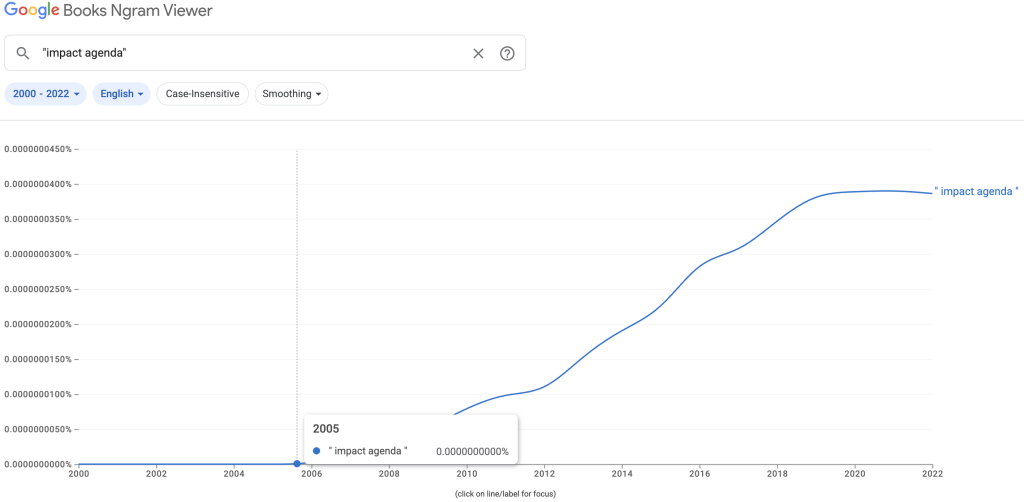
At AACSB’s annual get-together, the idea of impact was certainly on the minds of the business school deans and academic leaders in attendance. Notwithstanding the volatility occurring in global stock markets in the last week, conversations round the coffee urns centered on assessment, recruitment, and structural changes within delegates’ schools. In other words, the day-to-day impacts that any university administrator must deal with.
Impact questions
But broader impact was also being discussed. One well-attended session looked at advancing research impact and ‘innovative approaches to recognizing excellence.’ While such a discussion was welcome, for many audience members we had heard it all before. Questions such as ‘what is impact?’, ‘what impact truly matters?’ and ‘how do you measure impact?’ are well-worn, if still difficult to define in some areas.
It is over 40 years since Ed Freeman wrote the book on stakeholder capitalism, but this was one of the ‘innovative’ ideas put forward for supporting changes to broader impact measures. There were also suggestions for research to be summarized for practitioners to read, although abstracts have done this for decades, plain language summaries are well established, and AI can now do all of this and more in seconds.
New measures
The session did, however, nail what the problem is when it comes to rewarding broader impact. An example was shared of an operations research initiative which improved the logistics of food banks, meaning more resources were received by those who most needed it. What was rare about the research was that it had been well-cited AND its real-world impact had been measured. It was clear for everyone that metrics need to be redefined.
Cabells is playing its role in this shift. We have developed our SDG Impact Intensity rating with Saint Joseph’s University over the last few years, which you can see against some business and management journals included in our Journalytics database along with a host of other metrics. The most recent research in this space shows that the highest-ranked journals traditionally are starting to adopt SDG themes, albeit more slowly than other journals.
The AACSB also appears to be taking the need for accelerated change on board, forming the Future-Oriented Education group to look at a range of educational, industry, policy, and societal impact measures. One potential challenge for the group was presented in a case study from The Netherlands where the barrier to the adoption of wider measures was identified in the reluctance of senior academics to adopt new measures outside traditional publication data. The words leopard and spots come to mind.
New agenda
The rallying call for the session – and for many others at ICAM and no doubt other higher education conferences around the world – was that universities need to shape the standards to which they want to be held. This means adopting new measures and more varied measures, along with different timelines and approaches that drive behaviors. But the needle has not yet moved appreciably in this respect in the years since the impact agenda was first discussed, so we need to know how change can be affected as much as what the change should be.
Perhaps the answer lies in not waiting for others to shape the standards you want to follow as a school, department, or an individual researcher, but defining your own standards. Gather your own data. Set your own bars high and achieve them on your terms. Maybe then we can move on to a new agenda safe in the knowledge that the old agenda has finally been consigned to the history books.
