
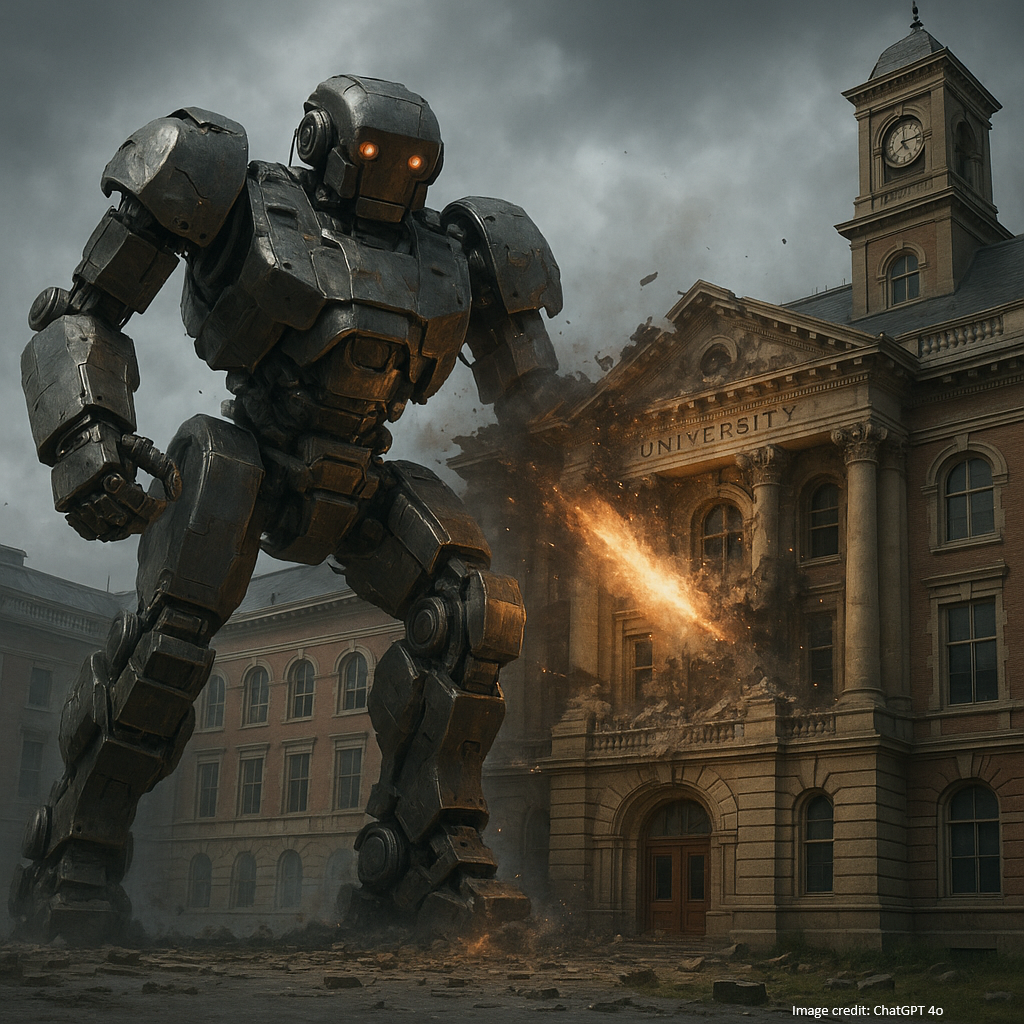
This week Simon Linacre presents our second blog post from the Academy of Management Annual Meeting held in Copenhagen at the end of July. After focusing on geopolitical changes and their impact on business schools last week, this week we turn to technological change, in particular the latest hot takes on AI and management education.
Just because you’re paranoid doesn’t mean they are not after you
Joseph Heller, Catch-22
Many of the sessions at this year’s Academy of Management conference concerned or included reference to AI. Indeed, there were so many sessions you would need AI to tell you about them, as few humans would be able to, or even bother, counting them all (ChatGPT says there were a dozen, “including themes like strategic decision‑making, human‑AI co‑innovation and AI adoption and policy”).
Two of the key sessions looked in different ways at the wider impact that AI use might have for research and business education as whole, but with contrasting vibes. While fear and paranoia stalked one session, the other attempted to view the upside of increased AI use.
Big guns
The first session brought together several big names from the world of management research, such as Ivey Business School Dean Julian Birkinshaw, FT Education Editor Andrew Jack, and INSEAD Professor Peter Zemsky. Hosted by London Business School Professor Michael Jacobides, the hope among the standing-room-only crowd was for some salient guidance regarding the ongoing impact of AI. However, the main takeaway was fear and uncertainty about what lay ahead for the industry.
The question posed to the panel was whether business schools were entering a “third era” of management education following the original practice-focused age in the early 1900s and the research-focused development from the 1960s. The current rapid growth of AI adoption seems to rival business schools’ core analytical capabilities, and as such, challenges their ability to educate and develop executives well-trained for an AI-dominated future.
There were some interesting answers posed, but few solutions. Jacobides said it was part of the job of business schools to ‘call BS on AI’ by developing critical skills, and this was backed up by UC Santa Barbara scholar Mary Tripsas, who not only gives her students the answers to case studies, but what ChatGPT’s responses are to cases, asking students to instead critique ChatGPT itself. Indeed, one moment of tension arose around the use of case studies, with some panellists thinking their time had truly come, while others thought their utility was on the wane.
Other problems facing business schools were neatly outlined by Jack, identifying ‘cognitive offloading’ of problems to AI, a noticeable drop in recent hiring from large white collar firms, and the unbundling of services as major challenges to the sector. Jack also pointed to the huge gap that persisted in academic research and real-world engagement – although he wasn’t probed on this in the session in terms of how the elite FT50 list of journals might have contributed to this.
Crack shots
Another missing link was any discussion about the cultural revolution that would be required within business schools to bring about the necessary changes to research. Specific, effective frameworks for sustainable research programs might at least be a step in the right direction here, as recommended by David Steingard from the Haub School of Business and David Reibstein from The Wharton School in their second paper at the conference. Here they offered new insights into the application of AI in academic research evaluation, sharing a new framework to make responsible business research more accessible, impactful, and matched with societal and sustainability needs.
As an example, they showed how useful AI could be in peer review, working alongside human reviewers rather than replacing them, and letting the AI do much of the grunt work under supervision. In this framework, all submissions were looked at and decided on by humans and a single Editor, but the process was faster, more consistent, and had LESS bias than traditional peer review.
The fear that some people have about the impact of AI on business education is probably not misplaced. However, from the discussions on AI and the future in general at AoM, there seem to be two camps. While some sit back and decry the passing of the traditional business school, others are immersing themselves in the new technology to see what it can do. You can worry about AI on either side of this divide, but by engaging with the technology, you at least won’t get left behind.
