
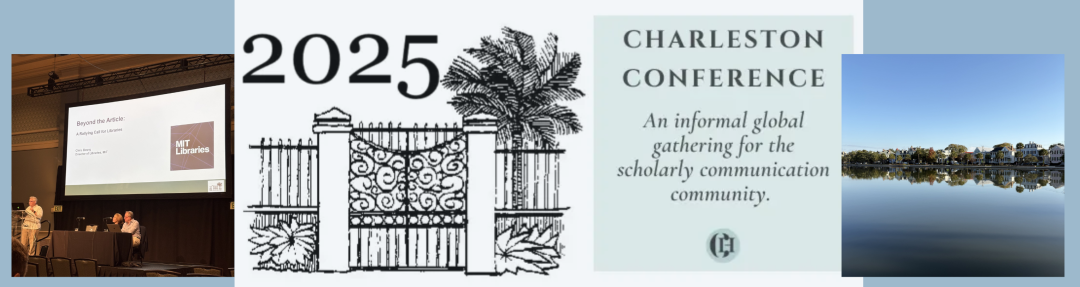
I was fortunate to attend the annual Charleston Conference last week, and in addition to the lovely weather and beautiful surroundings of South Carolina in early November, I was able to enjoy a vibrant and serious-minded event against a backdrop of unprecedented challenges. While there was an overall mood of deep concern for librarianship, there was also a resolve to meet the many and varied challenges head-on.


This was laid out in the range of talks that were given during the week, as well as in conversations during the manic single day that vendors exhibit at the conference. Compressing the exhibition into a few short hours makes for a long day, but also allows more space for the real business of knowledge transfer to take place – whether it be through learned plenaries or excited gossip.
Three-card trick
Perhaps the highlight for me was a session at the very end of the last full day, where three industry figureheads put together forceful arguments as to why the scholarly communication industry as a whole needed to move on from traditional journals and articles. The session was called ‘Beyond the Article: Reimagining Scholarly Communication for Equity, Impact, and the Future’, and featured Chris Bourg, Director of Libraries, MIT, Stephen Rhind-Tutt, President, Coherent Digital, and Alison Mudditt, Chief Executive Officer, Public Library of Science.

Chris Bourg kicked things off by challenging the status quo, asking what would happen if libraries invested in open infrastructure other than subscriptions and transformative agreements? Using the premise that all knowledge is a public good like roads, she made a radical argument to redirect 100% of library funds into preprints and open data sharing infrastructure. Following on from this, Alison Mudditt asked what if Open Access had succeeded technically but failed structurally, as it had not substantially changed prestige, profit, or publications. As such, she envisaged a future where publishers like PLOS could be service providers through connected systems across multiple outputs with full transparency, and where libraries would invest in the infrastructure and its sustainability using the “radical spirit” from the start of the OA movement.
Finally, Stephen Rind-Tutt encouraged the industry to go back to the purpose of universities, which was to improve society by conducting education and research. He argued that the pursuit of higher prestige had only equalled higher costs and the duplication of work in creating research articles, and for real-world impact to occur, there was a compelling need to look beyond the article. Examples of this were seen in making content open and breaking it down to be more accessible using AI. In such a scenario, libraries could be “engines of impact” moving into the post-journal world, with libraries leading the shift away from prestige.
Necessary structure
These arguments certainly make a strong case for the development of non-article units of content, and we have already seen these develop in the shape of data and code sharing across a range of platforms. However, what the arguments fail to reconcile with were revealed both in the probing questions the speakers faced after their talks, and other events happening away from the sleepy college town of Charleston.
At the end of the session, the first question that was asked was simply: If you take away the so-called ‘prestige economy’ along with journal metrics, and publish everything without review, how do we know what research to trust? The speakers struggled to answer this, suggesting AI might play a role (although trust is just as big a factor there, if not more so) and that there should be a focus on impact. A second question about how to help a non-traditional practitioner-oriented school prep students for traditional postgrad research programs also stumped the panel. Proposing a radical shift away from the norm is one thing, but answering the inevitable questions around practicalities is something else.
Wider contexts
While this debate was going in in Charleston, two reports highlighted the challenges faced by suggesting changes away from one channel of knowledge transfer to another without considering multiple channels and an option. On the one side, Deezer reported this week that it was seeing up to 50,000 new tracks A DAY being added to the platform, driven by AI technology enabling all bedroom wannabe rockstars to put music online. Moreover, according to a survey with Ipsos, Deezer said that 97% of people could not tell the difference between AI-generated and real music. Spot any parallels?
While we try to contend with AI slop on the one hand, on the other side, Elsevier reported in its latest Researcher of the Future report that the pressures felt by academics were rising. While just 45% thought they had enough time for research and only a third anticipated any funding increases, fully 68% said the pressure to publish had increased in the last two to three years. Crucially, three-quarters of respondents still felt peer reviewed research was both trustworthy and essential to research integrity.
So, we have some arguing for a move away from traditional articles as the units of research output, at the very same time as the industry sees the looming threat of AI-generated content flooding the knowledge base, while researchers are under increasing pressure to publish more research themselves with fewer resources. While moving ‘beyond the article’ is one answer, it cannot be the only one; an increased focus on high-quality articles, better delineation of research impact, investing more in research funding, and championing serious efforts at changing academic culture all need to be embraced as well. Otherwise, we will all be condemned to read AI slop, as well as listen to it.
