

You say you want a Revolution
Well, you know
We all wanna change the worldRevolution 1, The Beatles
Attending the Academy of Management conference this week in Copenhagen was disorienting in so many ways. It’s a traditionally US-based conference hosted in one of the most stereotypical European cities in the region; it was hosting some of the world’s best management brains, but was a chaotic mess of changing rooms, times and presenters; much of the talk was of AI and the impact of technology, and yet over 13,000 people were congregating in a single location to hear papers they could have read or viewed online.


However, some things have at least remained the same over the 20 years, on and off, I have been attending this event. There was a packed session on the future of business schools, where the consensus was that significant changes are really needed. And there were also calls for business schools to engage with firms more closely – a call that is as old as the business school itself.
Change management
What was different was that I was attending as a delegate for the first time after previously exhibiting at AoM as a vendor. This allowed me to attend talks as well as support co-authors Dr. David Steingard (Haub School of Business) and Prof. Dave Reibstein (The Wharton School) in presenting our paper on how the UN Sustainable Development Goals (SDGs) were represented by the FT50 – the list of 50 business and management journals that the Financial Times uses to rank the world’s top business school. Having previously been critical of the journals on this list for not engaging with the SDGs, our paper showed that more recently, the journals had increased their engagement with the SDGs by around 35%, almost double the rate of the set of SDG-focused journals indexed by Journalytics we had used for comparison.
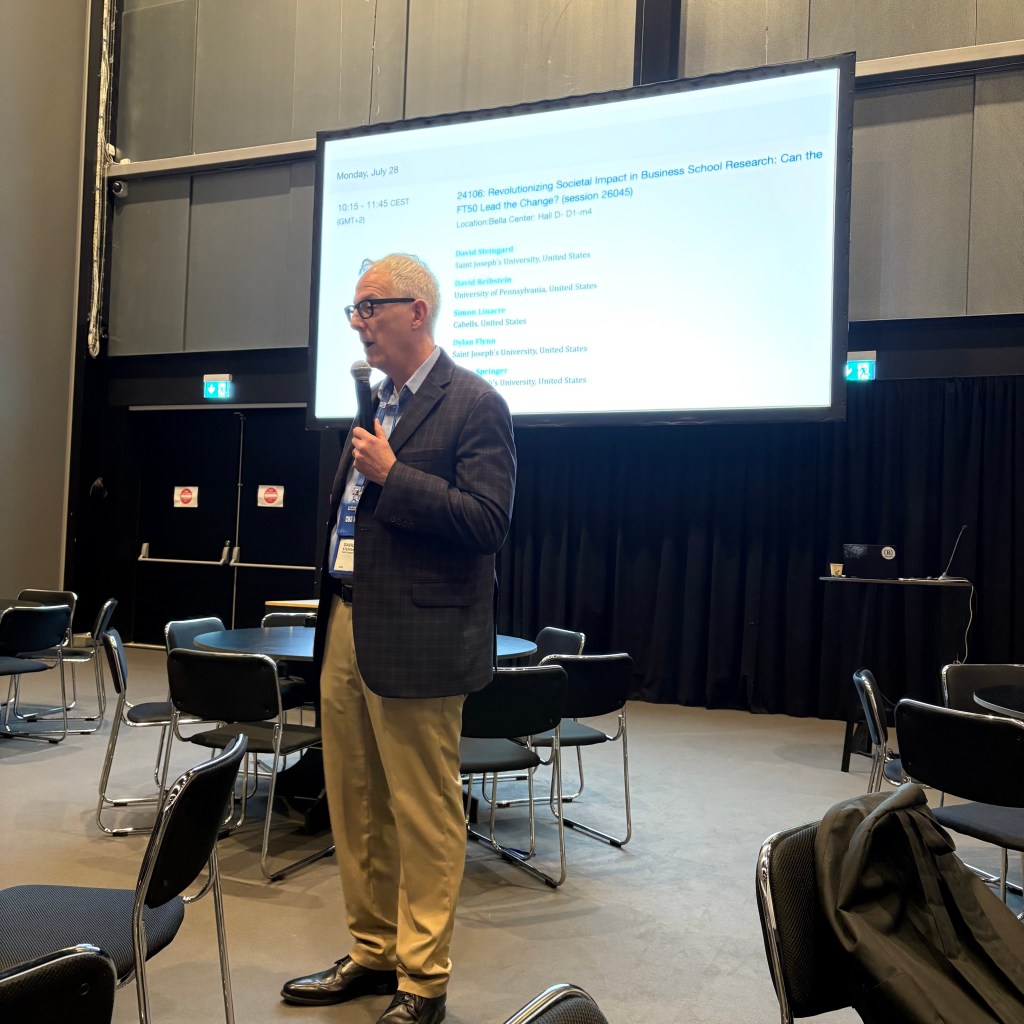
In presenting the study, Dr. Steingard cheekily commented that “AoM is not traditionally a place known for revolution”, but nevertheless, what we presented showed that for the first time, engagement with societal impact was increasing at a substantial rate across the range of elite management journals. Should this trend continue, we would see many more sessions at conferences such as AoM focus on the SDGs and the environment, marking a sea change in the way business school research has been undertaken.
Schooled by business
Two of the busiest sessions concerned the future of business schools, one from the threat of technology and another from the threat of geopolitical change. We will leave the technology review until next week as there was a LOT to unpack, but the discussion around geopolitical change was interesting as it drew in a wide range of people looking at all sorts of different impacts for businesses (and by extension, business schools) caused by the rise of populism across the globe.
The main thrust of the session was that firms were struggling to manage the risks – perceived and real – that populist policies represented, and that one set of tools that could be used were nonmarket strategies such as Corporate Social Responsibility (CSR) and Corporate Political Activity (CPA). While these strategies appeared to include significant risk at first glance, a range of case studies, surveys, and interview evidence showed that threats can be mitigated by looking at and anticipating long-term effects of nonmarket strategies rather than getting too caught up in the short-term impacts.
There are no doubt lessons here for the scholarly communications industry as well. We have seen that there have been immediate impacts from populist policies such as the withdrawal of papers, with longer-term impacts of funding cuts and changes in DEI policies well documented. The view from AoM is that these environmental factors will have negative consequences, but in the medium term are very likely to change, and staying as close as possible to principles will benefit business in the long run. So, while revolution may not happen just yet, things are already evolving. Even at AoM.
