
The UN Sustainable Development Goals (SDGs) have come in for a lot of criticism since they were adopted in 2015. Following on from the Millennium Goals, they were an attempt by the United Nations to offer guidance and purpose to researchers seeking to improve society through their work. Some people objected from the start that such a proposal should be offered in the first place, citing academic freedom to research anything they themselves thought was valuable. Others, however, welcomed a framework on which to build.
A decade on from their launch, and with the clock ticking down to the 2030 deadline, a timely report has just been published by publisher Springer Nature and policy impact outfit Overton. The report looks at the influence published research linked to the SDGs has had on policy around the world, with some interesting results.
Scaffolding, not building?
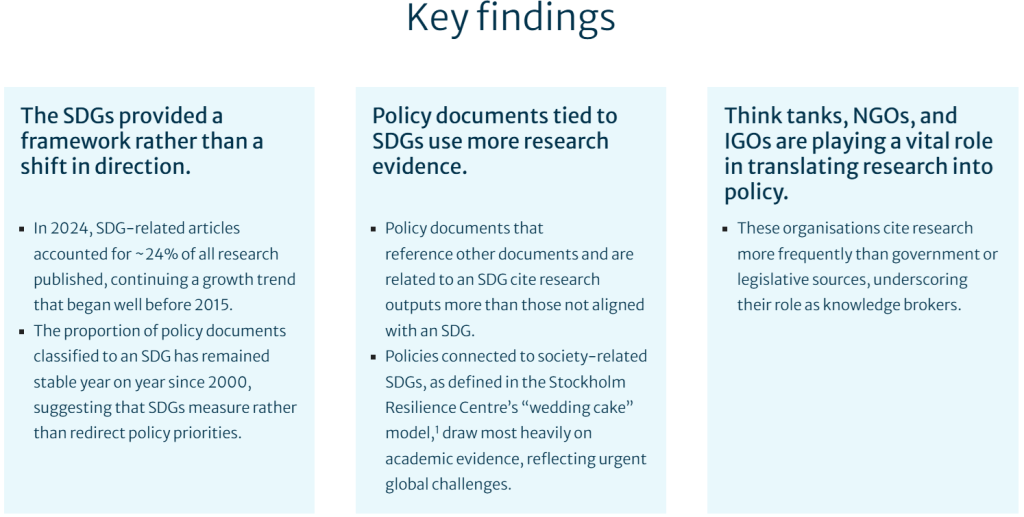
The standout finding in the report is that, in its words, “The SDGs provided a framework rather than a shift in direction.” By this, it means that while SDG-related articles accounted for around a quarter of all research published, the proportion of policy documents classified to an SDG has remained stable year-on-year since the Millennium. This suggests that while the SDGs have been good at providing a measure of impact, they may not have done anything more than redirect policies.
Furthermore, as one might have suspected, Global North research has a disproportionate influence on SDG policymaking, with 78% cited from authors based solely in countries such as the US, UK, and the EU. Indeed, the report also finds that Global South policy is strongly dependent on Global North research. For all the talk about impact that surrounds the SDGs, it seems that what impact there is has been there all along, and it is emanating from the wrong places.
Significant gains
It would be wrong, however, to overly identify the negative findings in the report, as there are some genuine wins to be celebrated as well. Policy based on SDG-related research is more likely to cite research than non-aligned policy, which shows the SDGs do punch above their weight when it comes to influencing policy. Key bodies that engage with SDG research include think tanks and non-governmental organizations (NGOs) – bodies that have a significant impact at both high levels and on the ground.
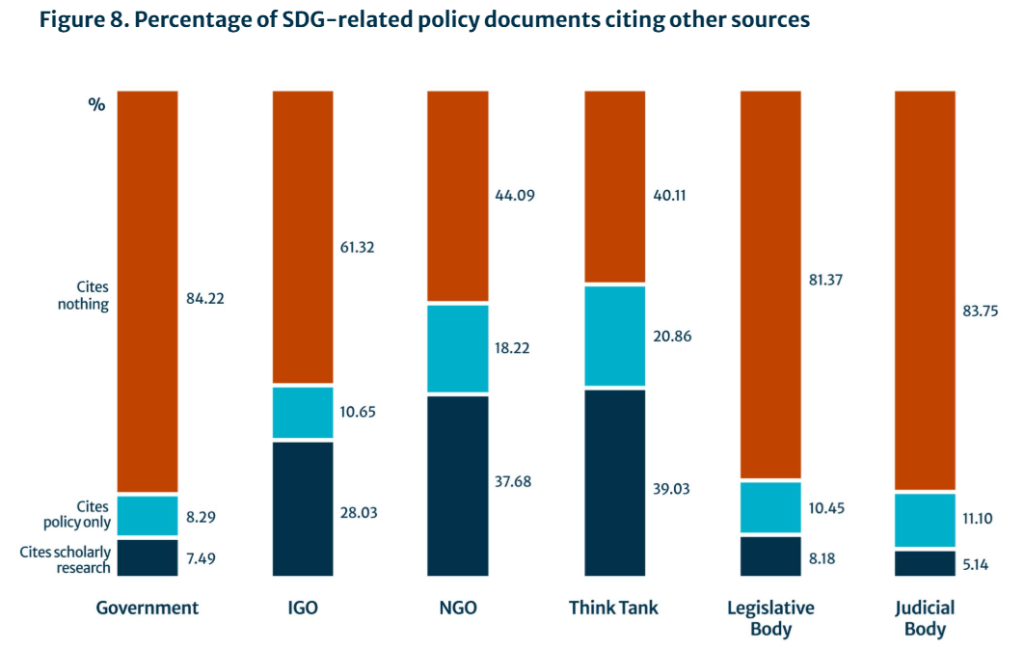
Percentages are calculated as the share of all documents within each source type. (Source: https://stories.springernature.com/sdg-impact-report/sdg-research)
When it comes to individual countries, there are also some myths being busted. For example, research from authors based in China tends to be widely cited in SDG policy documents, with Chinese research having a key role in areas such as global health and environmental policy. Other countries that stand out in their engagement include Australia, India, and Brazil, citing local research in 43%, 41%, and 40% of SDG-related policy documents, respectively. These countries therefore, show strong alignment between research and national policy goals.
Publish and (don’t) be damned
Cabells has supported the SDG Publishers Compact Fellows since its inception, with its aim of supporting a sustainable future through action as a publishing community. One of the great things about the SN/Overton report is that it both shows the type of publishing that has the most impact and the opportunities that still exist for the final years of the SDGs.
Gratifyingly for all those who have worked so hard at pushing Open Access models over the years, the report finds that OA is indeed linked closely with increased research impact in SDG policy, particularly for low-to-middle income countries (LMICs). Furthermore, OA also appears to be cited quicker and more frequently for SDGs than other research, showing that if you want to maximize the impact of SDG research, OA is the way to go.

In terms of opportunities, the report includes a long ‘to do’ list for publishers, including the prioritization of SDG-aligned publishing programs, building partnerships with think tanks and other organizations (something which the Publishers Compact has a special focus on), increasing the representation of Global South research – as well as actively supporting research with local impact – and commissioning ‘policy-ready’ content. Put all these things together, and we can see that while there have been challenges and the odd false dawn in the pursuit of the SDGs and impactful research, there have been many wins with a lot to play for. Let us just hope the powers that be can build a supporting geopolitical environment that enables further impact to take place, rather than hinder it.
