
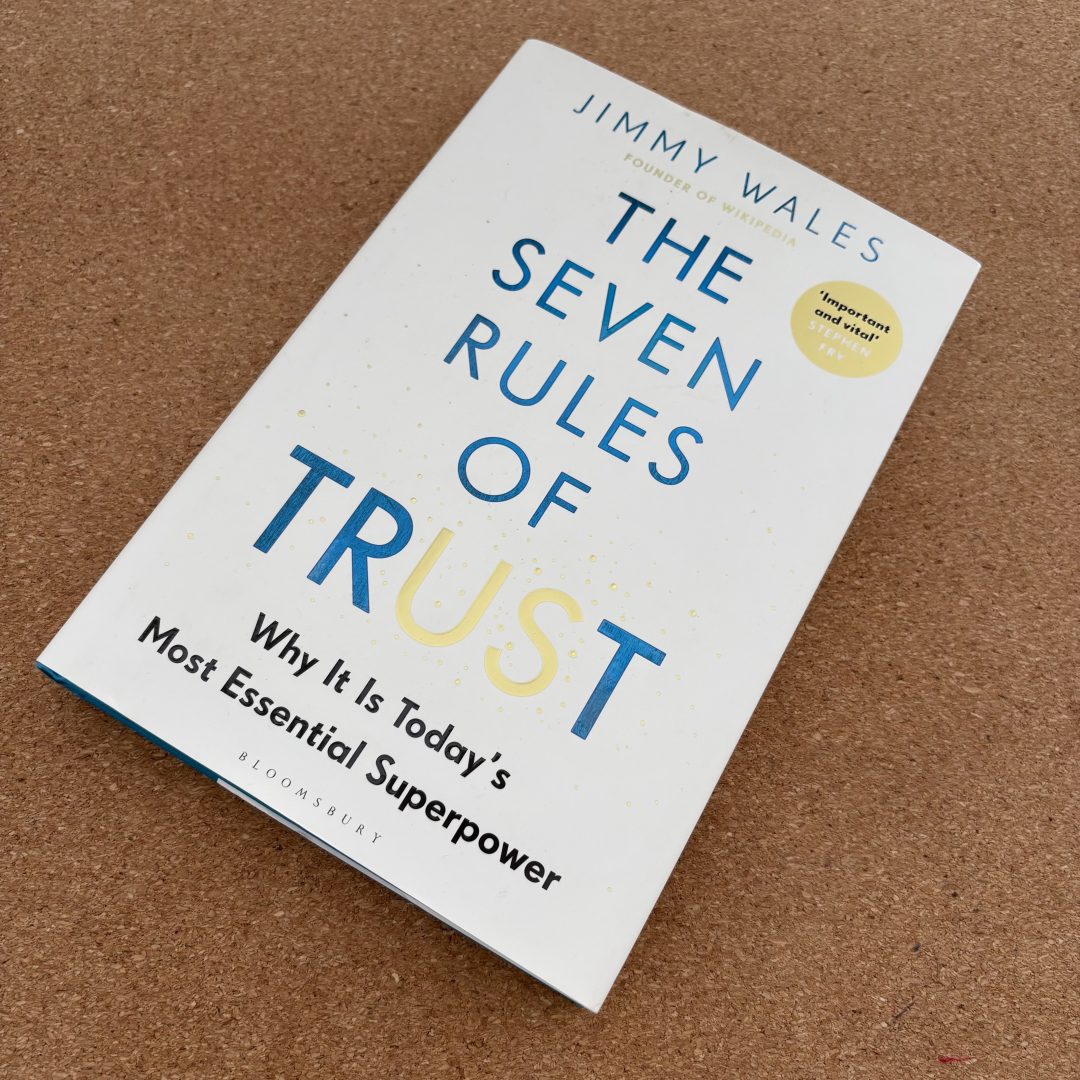
Trust is something we all take for granted. From taking an umbrella with you on a day out because the weather forecast said it would rain, to watching a movie following a friend’s recommendation, we commit to dozens of actions each day based on trusting something we have seen, heard, or sensed in some way. Of course, we live in a world where that trust is being undermined, a ‘post-truth’ world where it seems the fabric of much of what we are exposed to is falling apart. With such a state of affairs, how can we possibly turn things around?
On such a nihilistic note, hope is at hand in the shape of Jimmy Wales with his book, The Seven Rules of Trust. Part memoir, part business book, part self-help guide, Wales engagingly takes us through both his background and how that shaped him and ultimately led to the launch of one of the most successful websites in the world: Wikipedia.
Rules-based order
The book is fairly straight-shooting – although the rules themselves one suspects were created only after the website’s success – and offers a primer in not just creating a new destination for knowledge and rethinking the old ways (i.e., encyclopedias), but its most valuable lesson is in how to turn around an entity that was once a byword for flaky information into one of the most trusted knowledge repositories we have today.
How did this happen? Well, Wales puts it down to his seven rules, which are:
- Make it personal
- Be positive about people
- Create a clear purpose
- Be trusting
- Be civil
- Be independent
- Be transparent
Wales kind of cheats as he offers ‘one rule to rule them all’ at the end, namely ‘You must do it.’ Sweetly, he offers a UK expression to exemplify this, which is ‘do exactly what it says on the tin,’ which is from a beloved TV advert from the 1990s promoting a woodstain. This final element is needed for all the other rules to work, the idea being that if you do not show your purpose or your civility, then no one will perceive you have these qualities, and so trust will be more difficult to establish.
Industrial complex
There is much to glean for scholarly communications in Wales’ book, particularly at the moment as it grapples with the impacts of AI, research integrity challenges, and diversifying publishing models. Preprint servers have recently come under scrutiny following mixed reviews in the wake of the Covid pandemic and evidence that they are hosting ‘AI slop’ articles. But in the same way that Wikipedia answered questions about its integrity, there is hope that repositories may be able to do the same – indeed, this may be the thinking behind the recent news that arXiv has adopted a policy to ban authors found to post AI-generated articles.
AI seems to be at the root of where trust is being lost in publications and academia in general, from the Polish Nobel-winning author who admitted using AI in her writing to the supreme irony of an author who used AI to make up quotes… about the effect on truth that AI was having. In light of this, it is genuinely heartwarming to read a book like The Seven Rules of Trust that shows that things can be turned around for the better. In a recent discussion, it was felt that rather than technical solutions, in order to engender trust in scholarly communications again, we need to focus on changing culture, and this is where Wales’ eighth element comes into its own. As a result of a few people’s huge persistence and belief, Wikipedia became one of the most trusted sources of information on the planet. Maybe we need another movement like that one to show academic publishing can do exactly what it says on the tin.
