

Photo by Bermix Studio on Unsplash
Anyone who has published an academic article will recognize the feeling of despair when receiving an email like the one below – clashing color schemes, weird formatting and multiple typos all point to the same conclusion – some predatory publisher is trying for the sixth time this week to entice me into publishing in their poor imitation of a journal.
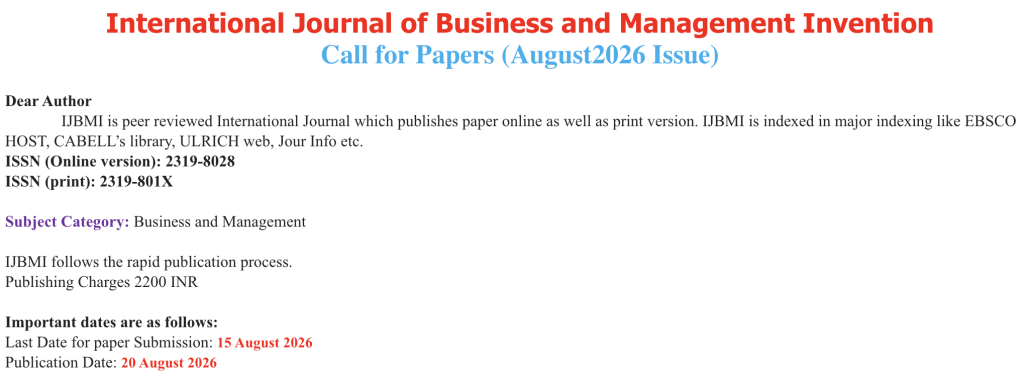
What makes this particular phishing attempt interesting, however, is that instead of the usual fake claims of a rocketing Impact Factor (though this does appear on its journal homepage) or burgeoning CiteScore, the journal announces that it is “indexed in major indexing” databases such as EBSCO, UllrichsWeb and – wait for it – our very own ‘CABELL’s library’ (sic). So, if a journal is to honor Cabells with a nod in its promotional mail shot, the least we can do is share what we know about this esteemed title.
Dubious beginnings
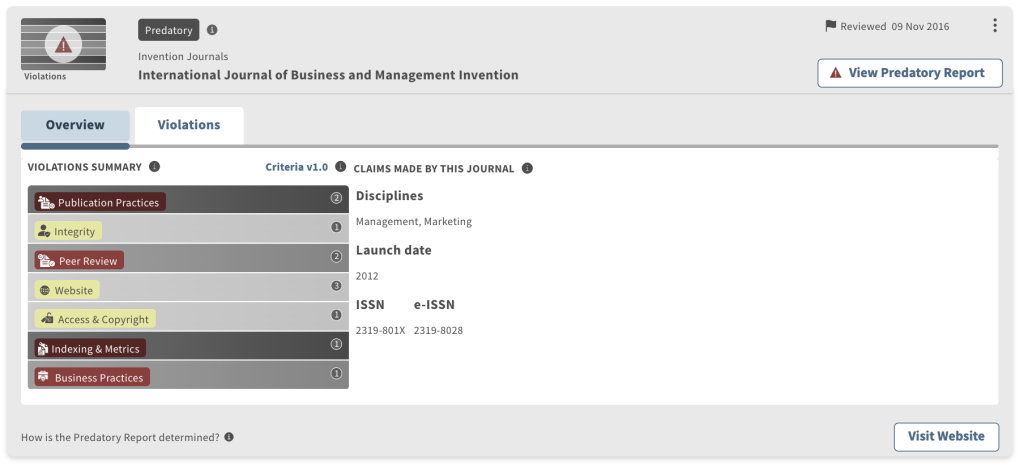
Firstly, let’s get some facts straight. The journal is categorically NOT indexed in Cabells’ Journalytics database, where we host a variety of data on good quality, robustly peer reviewed academic journals. It is, however, listed in Predatory Reports alongside over 20,000 deceptive journals that are of poor quality and undertake little or no peer review.
In this instance, IJBMI is in fact one of the very first journals recorded for inclusion in Predatory Reports, a full year before its launch in 2017. It was listed as we went through the painstaking task of building up the database, and with this example it was not a difficult decision to make to include the title as it had 11 breaches of our criteria at the time, one of the highest numbers in the entire collection.
Crimes and misdemeanors
As the image below shows, the journal fails to provide authors with a trustworthy, reliable platform on which to publish their research. It also fails in multiple areas in addition to false claims about indexation and metrics – it promises rapid publication and unusually quick peer review, does not have a clearly stated peer review policy and there is evidence it has sent invitations for editorial board members or reviewers to researchers clearly not in the field the journal covers.
Another clear indicator of predatory behavior is the publication of non-relevant articles to the journal’s stated discipline focus. The most recent edition– a bumper August issue including 11 articles – includes papers on ‘Recent Advancements in Parkinsons Disease’ and ‘Psychological Interventions for Managing Digital Dependency’. Not exactly core elements of Business and Management Invention, whatever that might be in the first place.
Most researchers receiving an email soliciting articles for this journal, promising publication within a matter of days, will quickly detect fakery at play and simply delete it forthwith. However, some researchers may be given pause if they are particularly in need of a quick publication, or if English is not their first language – especially if they see a trusted name like Cabells. Predatory publishers just need a handful of these authors to pay an APC for this journal to make the whole enterprise pay off, and they won’t care about the irony that they are included in a Cabells database, but for all the wrong reasons.
