

A little over a year ago, Cabells dipped its toe into the AI ocean and launched the beta version of CompassAI – an independent, cutting-edge tool for researchers to identify the journals with the best fit for their research. The launch has been incredibly successful, with great customer feedback and new use cases we hadn’t even thought of ourselves.
Twelve months on, and we have used that feedback to fully launch CompassAI today. As well as improved user experience (UX) and design, we have also added new filters and other enhancements to further improve the tool’s utility. As a result, we believe CompassAI is the premium independent journal selection tool available – with the added benefit of knowing all 20,000+ predatory journals have been screened out, leaving only recommended journals from our Journalytics database to choose from.

How CompassAI works
The essentials of CompassAI have remained the same. Simply insert an abstract, introduction or short summary of an article into the text field, and the software analyzes the content to find those journals that match its scope from across the 14,000+ titles indexed across our Journalytics database. It then uses the unique data we have on each journal to identify and share the most relevant journals from 320 disciplines and over 500 academic topics.
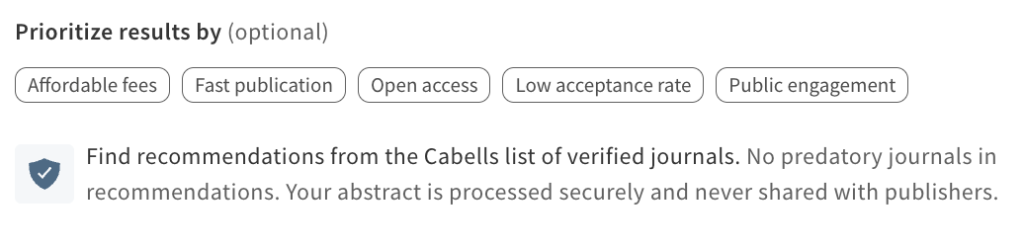
New to the full version of CompassAI is the ability to filter results by a number of different ways:
- Affordable fees
- Fast publication
- Open access
- Low acceptance rate
- Public engagement
Safe AI
One common question from customers in the last year has been how our AI has been used in the software, with concerns that data might be harvested or errors be introduced. This is categorically NOT the case – no data is captured from any user of CompassAI, while the AI itself is used in a safe environment, utilizing only verified data for its work.
We have been very pleased with the response so far from customers and the trust they have placed in our independent tool – indeed, one said that “within a publisher’s tool, I would worry that it would advantage it’s high-APC titles over other options because publication in those would earn more profit. I prefer to prioritize the use of scholarly communication tools which have no monetary, publication-related conflicts of interest”. The good news is that we have another independent, AI-based tool launching… but more about that at a later date!
Image: Adobe Stock
