

Several months ago, we posted a blog about the emails most academics receive on a regular basis from predatory publishers, where they flatter the recipient and solicit an article submission from them even though the journal often has nothing to do with their area of expertise. Often, these emails are caught by the junk email filter or are so ridiculous that they warrant no further action other than deleting them straight away.
However, what about those emails that do bear at least the trace of legitimacy, and how do we deal with them? Below we have listed a number of emails that we have received into our own email inboxes and delineate the real from the fake – although sometimes it isn’t as easy as you would like to think.
Exhibit A
First up, an easy one – the International Journal of Engineering Inventions
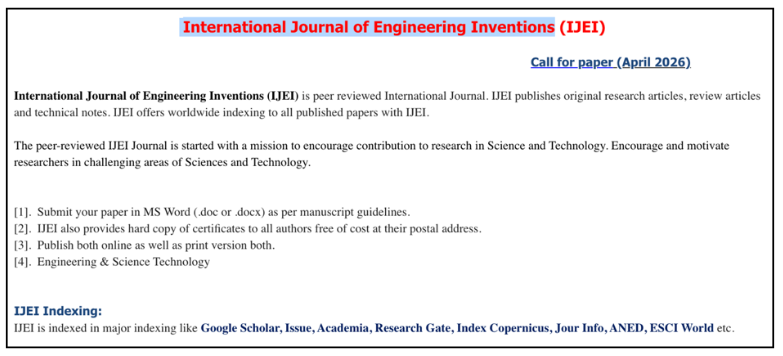
Tell-tale signs that this journal is predatory are the spelling errors (‘Call for paper’ instead of ‘call for papers’), provision of hard copy certificates, nonsensical text (‘Engineering & Science Technology’) and a list of indices which are either not an index (Google Scholar), known for including predatory journals (Index Copernicus) or unknown (Issue).
Together with the broad subject area and simplistic email design, the indicators are clear that this is a predatory journal, and indeed this has been included in Cabells’ Predatory Reports database after a prior review.
False positives
Another tell in solicitation emails is the benefits on offer, such as those below from an engineering journal:
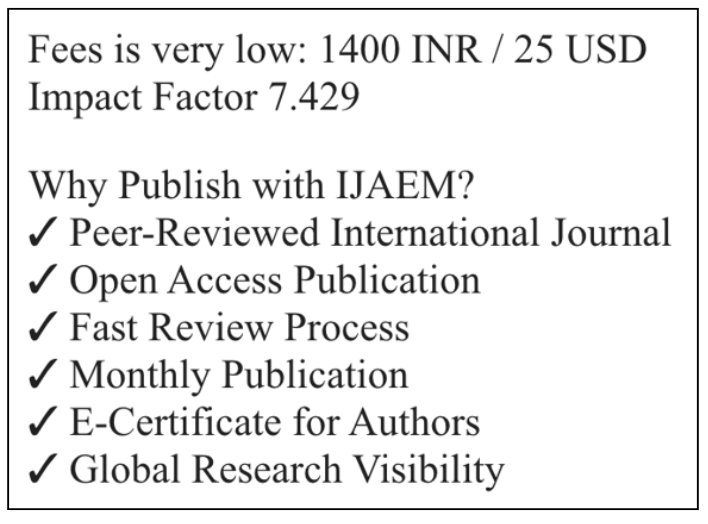
At first glance, offering a list of benefits to an author such as these may seem OK, but on closer inspection there are clear issues. A $25 article processing charge (APC) is extremely low, whereas most publishers charge $2,000-$3,000 to cover publication costs. Also, not only is an Impact Factor of over 7 high for an engineering journal, but it’s also made up – this journal is not indexed by Web of Science, which can easily be checked via its Master Journal List.
Flattering to deceive
Checking if a journal is in a major index is one of the essential things authors need to act on in order to do their own due diligence on a journal – whether they are looking to publish in it, or cite an article published in it. Predatory journals don’t tend to do any meaningful peer review, therefore, any research published in them has not been verified and cannot be trusted to support any individual’s research. Claiming indexation is an easy way to try and show legitimacy, such as in the example below:
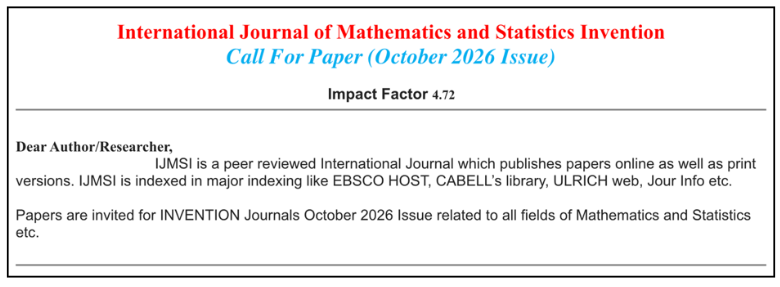
As you can see, we have another (false) claim to a high Impact Factor, as well as indexation in something called the ‘CABELL’s library’. Not only do we not have a library, the name of the company is Cabells not Cabell, and more importantly we do not index this journal in our Journalytics index – but we do list it in Predatory Reports.
Plot twist
While these emails may seem clear-cut examples of predatory journals soliciting submissions, sometimes legitimate journals muddy the waters by sending ill-advised emails to people on their contact lists. For example, see below for one sent out last month:
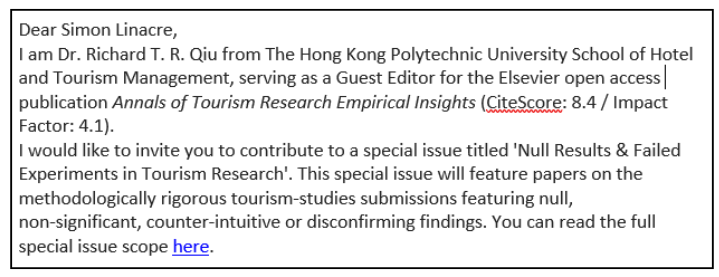
Now, this email is verifiably legitimate. The Guest Editor is indeed at HKPU, the journal has a CiteScore and Impact Factor corresponding to the metrics presented, and the link leads to the Call for Papers on the journal’s homepage on Elsevier’s website. However, why this email was sent to me, who has zero publications in either tourism research or methodology, is somewhat of a mystery. And the inclusion of metrics claims high up in the email, albeit true, also fits the template employed by deceptive publishers.
To be clear, this last example is from a well-cited, legitimate journal as opposed to the clearly predatory journals above. However, in the same way that authors should check the journals they use, publishers seeking to widen their author base have to be very careful in the execution of their marketing. Otherwise, they undermine the whole reason for these activities in the first place.
