

A little-examined consequence of the predatory publishing phenomenon is the damage done to legitimate publishers that got swept up in it – not because they were truly predatory, but because they were listed alongside journals that were.
Beall’s List, the well-intentioned and perhaps the most famous predatory publisher and journal list, has long been shuttered. Despite that, the digital record persists. Archive sites and mirrors picked up where Jeffrey Beall left off. Now, nearly a decade later, multiple versions still circulate online, carrying forward the old judgments as if they were current.
Some publishers still grapple with their listed status, even if they’ve remediated what they were labeled for. With no means to clear their name, they frozen like an insect in amber.
The amber effect
An insect trapped in amber is perfectly preserved, unable to change, held exactly as it was at the moment of capture. Publishers listed on a mirror site incur this “amber effect” with their status in limbo.
Publishers remain entombed in amber as “predatory” because there’s nowhere they can demonstrate their improvement. Mirror sites are mostly unmanaged and, while some add minor notes or link updates, the underlying judgments don’t change – a snapshot from 2017 or earlier is treated as a present-day truth.
The history and reality barely register for most authors and institutions, as Beall’s List has a kind of talismanic authority in the scholarly world. It’s well-known, easy to use and binary. Yet that simplicity comes at a real cost to publishers placed on the list years ago for reasons that no longer hold or were insubstantive to begin with.
Getting off the list
The publishers that exited Beall’s List before it went offline often had the means to apply pressure. Yet not all publishers had that luxury, or enough time, and therefore fell victim to the amber effect. They were, and still are, incapable of being exonerated or lack the clout and leverage to act. They’re in contrast with some larger publishers that had been listed but could escape before Beall pulled the plug.
For example, Bentham Science Publishers (including Bentham Open, which Beall listed), was initially added after editors accepted two computer-generated papers. Both were flagged and rejected during the peer review process and never published, but the listing stood, regardless. It now handles more than 25,000 submissions a year across a portfolio of more than 200 journals. Yet it has no chance to clear its name.
In the case of Avicena Publisher, Scopus and Web of Science both rejected its journals for indexing based on the Beall’s listing alone. This happened even though the publisher publicly documented that the listing stemmed from complaints by two individuals rather than any demonstrated pattern of misconduct.
InTechOpen also sharply illustrates the amber effect. In 2016, Sage acquired five of its journals, reflecting Sage’s own due diligence on quality. Mirror sites, however, still list InTechOpen as predatory, with the contradictory indication that newer issues of those same journals should not be considered predatory. Vetted and accepted by Sage, but flagged and frozen indefinitely.
Other publishers across medicine, biology, and other disciplines also carry a legacy label with no recourse.
Authors who check a mirror site when searching for a journal, and find a publisher listed, avoid submitting there. Librarians reach for familiar warning signals. Legitimate journals lose submissions while authors may even redirect their work to publishers that have never been scrutinized.
Responsible vetting
Static lists were useful at a time when no systematic vetting at all was the alternative. But we’ve moved on and the gap between what legacy mirrors offer and what journals and authors actually need has become increasingly hard to justify.
2025 Retraction guidelines update: key changes
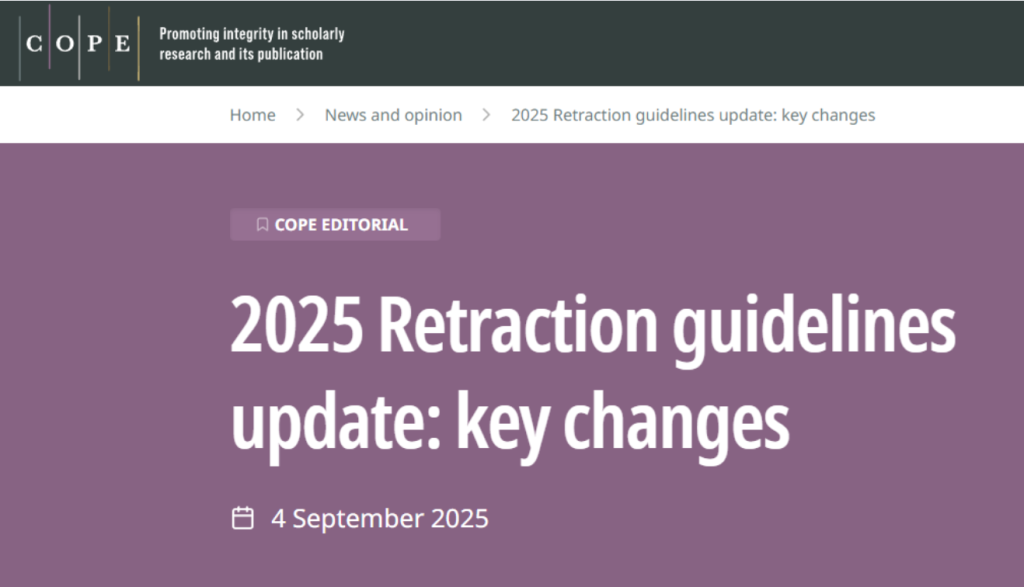
The scholarly community’s broader direction of travel is worth noting here. COPE’s 2025 retraction guidelines update doesn’t vet publishers, but it reflects the same corrective logic that’s needed: that integrity infrastructure should be designed to fix problems, not permanently brand actors for past issues. The update introduces batch retractions for coordinated manipulation, a “retraction with replacement” path for fixable errors, and allows editors to act when they lose confidence in a paper – even without proof of fraud.
The Directory of Open Access Journals (DOAJ) and national classification systems like Finland’s Publication Forum (JUFO) approach publisher and journal assessment by applying transparent criteria, updating their judgments as new evidence emerges, and removing journals that no longer meet the standard. JUFO’s 2024 and 2025 downgrading of certain journals to Level 0 is a good example: a live, evidence-based call on current practice.
Think. Check. Submit. represents another model – shifting responsibility toward the researcher rather than relying on a single authoritative list. It provides authors with a checklist of questions to evaluate a journal before submitting:
- Is it indexed in a trusted database?
- Is the peer review process clearly described?
- Are the editorial board members verifiable?
This type of practiced habit of scrutiny is more durable than dependence on a frozen registry.
Frozen lists won’t fix predatory publishing
The underlying problems Beall’s List was built to address still haven’t been resolved. Journal hijacking is adding 70–80 new entries per year to the Retraction Watch Hijacked Journal Checker and paper mills are coordinating fraud across publishers at scale.
But a frozen list can’t distinguish between a genuinely predatory publisher and one that made a remediable error a decade ago and corrected it. Treating both identically is a failure of the vetting infrastructure. A system that permanently punishes a past snapshot, with no pathway for redemption, harms the scholarly ecosystem it was designed to protect. One alternative is Cabells Predatory Reports.
Trust in scholarly publishing can’t be built on snapshots. No publisher or journal that has righted its ways or successfully proven its innocence should be indefinitely and inescapably frozen in amber at a single timepoint. Publishers, like journals and like the research they communicate, change over time. The tools we use to evaluate them must do the same.
Ed. note: With sincere thanks to Gareth Dyke, formerly of Bentham Science and co-founder of Sci-Train, and Adam Goulston, owner of MacroLingo.
Header image credit: ChatGPT
